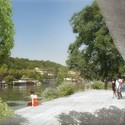
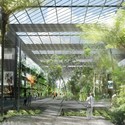
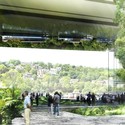
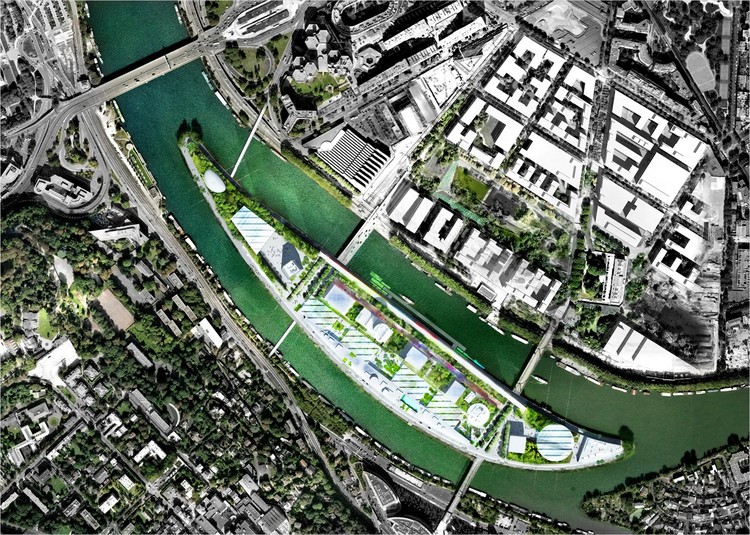
Jean Nouvel was chosen as the lead urban architect and coordinator for the Seguin Island project in July of 2009. Here we are sharing with you the Ateliers Jean Nouvel team master plan for Seguin Island in Boulogne-Billancourt, France.
A diverse group of programs will make up the spaces, total surface area of 300,000 sqm, including cultural, retail, social facilites, parks, gardens, terraces serving as a destination for both residents and tourists. Construction is scheduled to begin in 2010 and final completion is expected for the end of 2023.
Follow the break for a video and renderings by Ateliers Jean Nouvel.
Swedish architects Jagnefält Milton shared with us their proposal, awarded with the third prize in an open international master plan competition for the city of Åndalsnes in Norway.
A little description and more images after the break.
Dutch urban planners POSAD, shared with us their proposal for the Solar Park South Competition in Italy, for which they received an honourable mention. More images and press release after the break.
Department of Unusual Certainties is a Toronto-based research and design collective working at the interstices of urban design, planning, public art, spatial research and mapping have shared with us their contribution to the John Street Ideas Competition, held by the Toronto Entertainment District BIA, entitled StairSpace. The competition called for a new public space concept as the center point of what has been dubbed a major cultural axis in the Toronto – John Street. More details of DoUC’s submission after the break.
HENN ARCHITEKTEN‘s design and research studio, HENN Studio B, has been awarded first prize in the international competition to design the new central Business District in Wenzhou, China. They have kindly chosen to share with us their winning proposal, providing additional images and a succinct description after the break.
The CDR-CDU Master plan by Nabito Arquitecturais directed by the desire to create self-sufficient enclosures in the proposed Blocks in order to fight against the abusive urban texture that has developed over the past 50 years on the site. The architects have tried to create an operational space within each of the Blocks in the master plan in hopes that future development of each individual Block will link with one another.
When I visited Chicago, I had to visit one of the key actors on shaping a city that breaths architecture, from big part of the skyline to the Millenium Park: SOM.
I have visited SOM before, to interview Craig Hartman at the San Francisco office, but Chicago was were it all started back in 1936 with Louis Skidmore and Nathaniel Owings, and John O. Merrill who joined in 1939.
This time I interviewed Philip Enquist (FAIA), the partner in charge of urban design and planning. Philip has been involved in development and redevelopment initiatives for college campuses, existing city neighborhoods, new cities, rural districts, downtown commercial centers, port areas and even in a master-plan for the entire nation of Bahrain.
It was amazing to hear from him on different processes that have been shaping the most important cities in the world, such as Beijing’s Central Business District or the master plan for the Millenium Park. But I was also surprised about a project we presented to you earlier, the vision for the Great Lakes area, a project that shows a lot of responsibility as an architect and an example that we still have a very important role in our society.
After the break, the usual questions a bonus with what’s a good city, and some photos of the office.
“(Driver)less is more”, BIG’s proposal for the Audi Urban Future Award was one of the five finalists of the competition won by J. Mayer H. More images and architect’s description after the break.
Here’s the third proposal by Rocco Design Architects Limited for the West Kowloon Cultural District (be sure to view OMA’s proposal and Foster + Partners’ proposal previously featured on AD). Rocco’s concept, entitled ”Cultural Connect: Key to Sustained Vitality,” started with two basic questions - Have we ever wondered why we are fascinated by Qing Ming Riverside? And, why exactly do we want a West Kowloon Cultural Dsitrict. Using these questions are a starting point, the proposal seeks to design a place where different groups of people can enjoy different activities “in the same space and at the same time.”
More about the proposal including images after the break.
Continuing with our coverage of the West Kowloon Arts District, here’s Foster+Partners’ proposal entitled City Park. The proposal is based around a 23-hectare Great Park which will hold a sampling of cultural buildings of varying scales. From the large Arena, Opera House and Exhibition Center to the smaller teahouses and small temples scattered throughout the landscape, the park will be a welcoming entity programmed to provide for the public. Lord Foster, Founder and Chairman, said, “Hong Kong is a great city and this project captures what is important about its DNA: the civic spaces, the squares, the parks, the greenery, the avenues and the small side streets. At ‘City Park’ we have created a world class setting for a new cultural city for everyone.”
More images and more about the master plan after the break.
On Monday, we shared OMA’s master plan proposal (a series of 3 villages that re-think traditional arts components) for the West Kowloon new arts district. As we mentioned, OMA’s plan is competing with two other master plans – Foster + Partners and Rocco Design Architects Limited. We’re excited to share these two master plans with you this week and get your feedback for the plan that you feel is most successful.
This past week, the West Kowloon Cultural District Authority of Hong Kong unveiled OMA’s conceptual master plan for a new arts district (Koolhaas’ plan is one of three competing proposals). Divided into three villages, the 40 hectacre waterfront site places strong emphasis on the quality of the street life and the “cultural production where all aspects of the creative process are nurtured and made visible.” The master plan has been years in the making, as Koolhaas established an office in Hong Kong to better understand the culture and context, as well as collaborate with financial and culture experts to design a feasible plan to positively affect the communities involved. Rem Koolhaas commented, “Using the village – a typology every citizen of Hong Kong is familiar with – as the model for our plan allows us to absorb the massive scale of WKCD’s ambition into manageable portions and forge deep connections with Kowloon, whose vital urban energy will be the lifeblood of WKCD.”
Images and more information about the master plan after the break.
Earlier last week, the City Council of New York City decided to move forward with Rafael Viñoly Architects’ master plan for the New Domino in Brooklyn. While the historic sugar refinery complex, with its familiar yellow signage, has achieved landmark status and will be preserved, the 11.2 acre-site will be outfitted with 2,200 new apartments – 660 of which are affordable housing – and four acres of public park space including a riverfront esplanade along the East River in Brooklyn.
Recently awarded first prize,Woods Bagot’s vision for the Shijiazhuang International Exhibition and Convention Center will be manifested in a sleek faceted glass tower that rises from smaller geometric exhibition halls. The master plan is designed to uplift the city’s coastal area, which is currently underdeveloped, by attracting tourists and locals to the entire complex for different programmatic activities.
More images and more about the master plan after the break.
During the post-WWII era, the surge in the housing market often resulted in “faceless” suburban communities that sprang up to relieve the immediate need for housing. The cities maintained their cultural identity and rather than the suburbs infusing their new communities with commercial or cultural entities, the suburbs constantly relied on the city’s proximity for such things. As this old model is highly unsustainable and car dependent, Christoph Vogl from Cheungvogl has studied Long Island’s suburbs, in particular Hempstead, that did not grow as independent communities. He has outlined a master plan of what can be done to give Long Island the social, cultural and economic context it needs.
“Very much representing these observations, the so-thought town centres of Long Island’s communities, placed around the major traffic intersections are not occupied by cultural, commercial and social institutions, as expected from the ratio of communal identity and urban context, but by parking lots. Not some, but hectares of paring lots. Not complaining about the non-existence of urban context and real community, these vacant areas around Long Island’s “Cross roads” offer the unique chance for master planning based reconsideration of the meaning of community,” added Vogl.
Check out the steps of the master plan after the break.
Jeffrey Pongonis’ blog, MSI Design – Beyond the Studio, is chock full of urban issues ranging from new green initiatives to schematic designs for new developments. What attracted our attention was the strategic plan for Columbus Ohio, an initiative to restore Downtown’s vitality by building upon the area’s success from the 2002 Strategic Business Plan for Downtown Columbus.
More about the plan and more images after the break.
Field Operations and DS+R’s High Line has been enjoyed by many ever since its opening, but we’ve been waiting patiently for the next segment to be finished. And, thanks to Curbed.com, we’re able to share some recent construction shots of the progress being made.
Check out more photos and more about the second phase after the break.