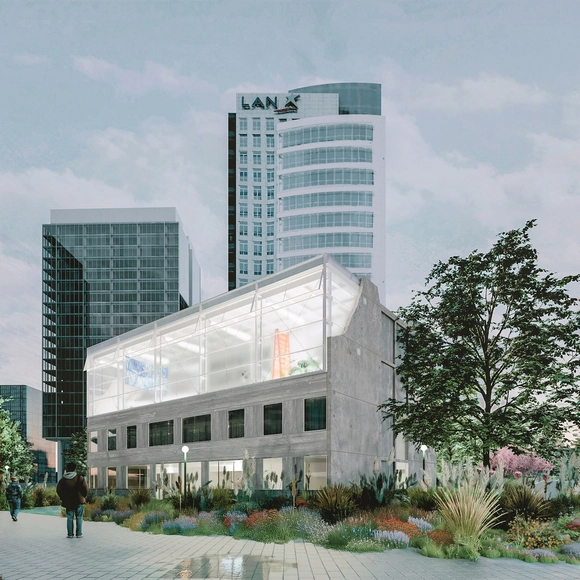
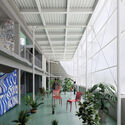
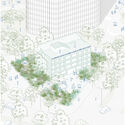
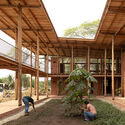
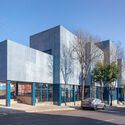
The residential project Villa San Luis, originally named Villa Compañero Ministro Carlos Cortés, was built between 1971 and 1972 on land that today lies in one of the highest-income areas of Santiago, Chile. Initially designed as an urban center for 60,000 middle-income residents, with staggered buildings and a civic center covering 3.4 of its 50 hectares, the project was redefined in the 1970s to accommodate the unhoused population in the eastern sector of the Chilean capital. The process was not without conflict. During the dictatorship, the new residents of the complex were evicted, and the land was acquired by the military. From then on, the complex entered a process of reappropriation and resignification that now appears to be reaching a new milestone: the conversion of one of its buildings into a memorial site and museum, through a project by UMWELT and Plan Común.
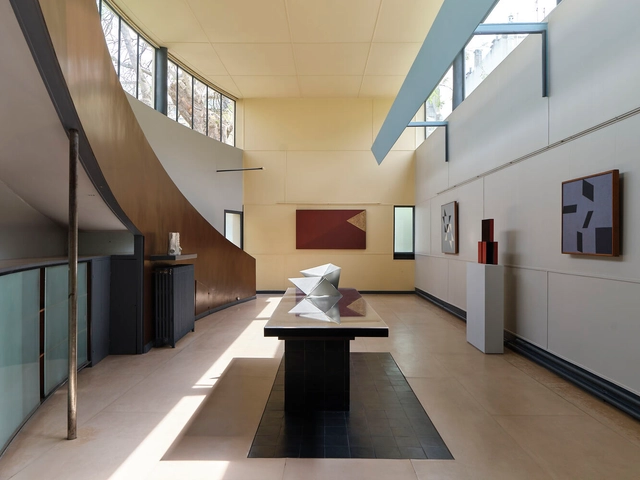
Founded in 2022 by art advisor Filipe Assis, ABERTO is an exhibition platform celebrating the convergence of art, design, and architecture in Brazil and beyond. Staging exhibitions in private and public modernist spaces, its past editions have highlighted the global connections forged by Brazilians from the 20th century onwards. Following three exhibitions in São Paulo, "ABERTO 4 – Brazil After Le Corbusier" marks its first international edition, taking place at Le Corbusier's Maison La Roche in Paris, from 14 May to 8 June 2025. The exhibition presents around 35 design and art pieces by Brazilian artists, spotlighting Le Corbusier's seminal connection to Brazilian modernist architecture and exploring his influence on contemporary Brazilian creatives. Previous editions of ABERTO have featured over 100 artists from Brazil and abroad in houses designed by Oscar Niemeyer (2022), Vilanova Artigas (2023), and Ruy Ohtake and Chu Ming Silveira (2024).
The 19th edition of the Venice Architecture Biennale officially opened to the public on May 10, becoming a significant international platform for exploring the current state of global architecture and sparking conversations about the challenges the discipline faces today—both shared and specific to each territory. This year’s theme, "Intelligens. Natural. Artificial. Collective," proposed by general curator and Italian architect Carlo Ratti, invites reflection on architecture’s interconnection with other fields—such as art, artificial intelligence, and technology—while also emphasizing the importance of territories, landscapes, and, above all, the people who collectively shape our built environment.
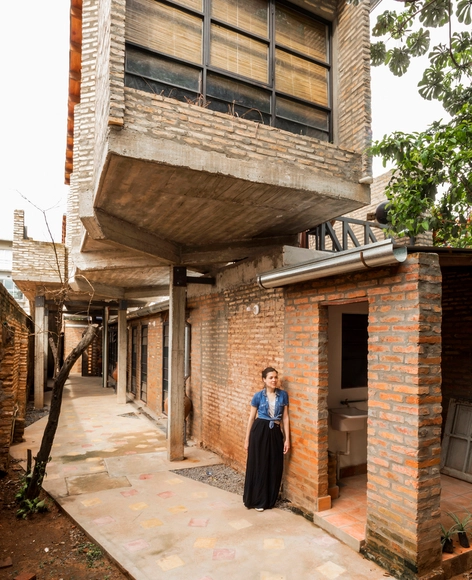
What makes a building architecture? The eternal debate over what distinguishes architecture from mere utilitarian construction has often included affordable and social housing as an influential topic, sparking different points of view. This question is particularly significant in the Latin American context, where unique conditions go beyond cost concerns, whether imposed or unavoidable. Limited access to financing, the prevalence of self-construction, and the spread of informal settlements are interconnected factors shaping the built environment. These dynamics foster an aesthetic that, for some, challenges notions of good architecture, manifesting in urban landscapes where exposed materials become a defining feature.
https://www.archdaily.com/1024259/unpolished-narratives-exposed-materials-in-latin-american-affordable-housingEnrique Tovar & José Tomás Franco
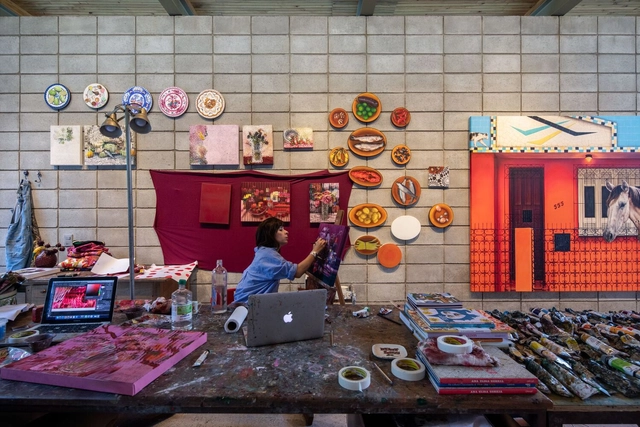
The spaces where artists create their work reveal a great deal about their creative journey—their techniques, themes, and inspirations. These places hold memories, intimacy, and emotional connections. For some artists, the studio is a secluded space, free from distractions. For others, it is a place for openness and freedom. Often, the studio becomes the home—or the home becomes the studio—blending function, desire, and necessity. Positioned at the crossroads of living and creating, leisure and work, these spaces fascinate art lovers. Many are later recreated in galleries or transformed into museums. Regardless of the artist’s fame, these spaces offer a unique look into the creative process, the artwork, and the artist's identity.
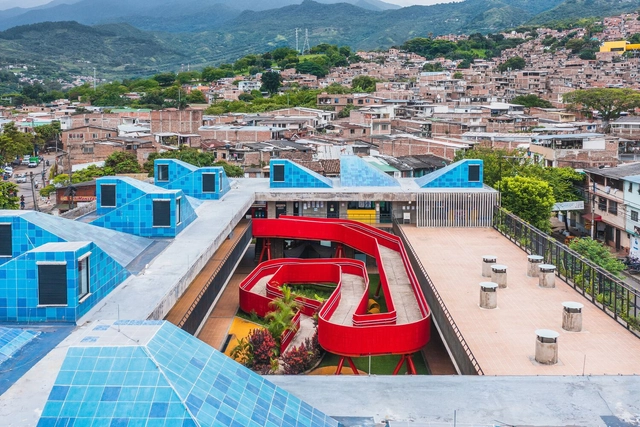
A change in the way architecture was practiced in Colombia was necessary, and Taller Síntesis emerged to materialize this transformation. The studio combines a deep understanding of the territory and its context with architectural solutions that translate into materiality and built spaces. Their works stand out for their strong local cultural identity, achieving a precise balance between the preexisting, the new, and harmony with the landscape.
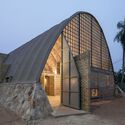
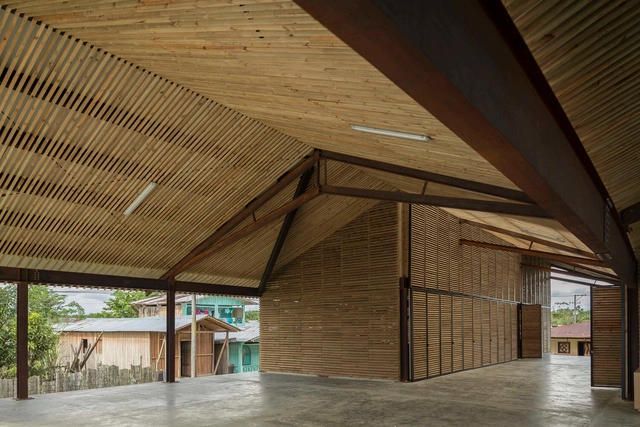
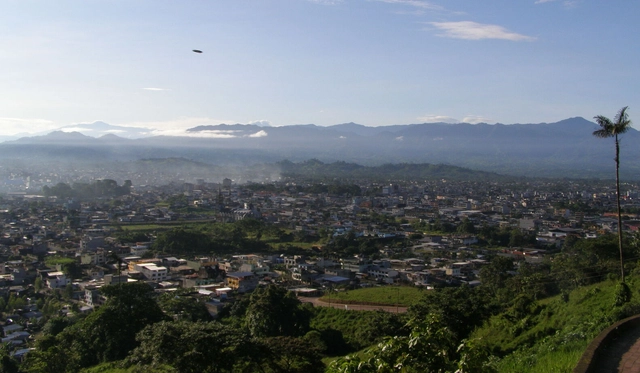
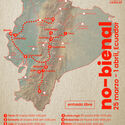
Happening throughout 8 days across 12 cities from north to south of Ecuador, the "no-bienal" biennale is holding its second edition from March 25 to April 1, 2025. Its unique name is devised to stand in opposition to the competitive structure that characterizes traditional biennials in the discipline. One of the objectives of this new edition is to demonstrate that there is unity in Ecuador, resisting the political strategies of division. Escuela Radical, the educational collective at the center of the event's organization, asserts that "it is not about centralization or decentralization, but simply about sharing without competing."
Videos
Courtesy of Katia Sei Fong, Ken Sei Fong, Luis Sei Fong
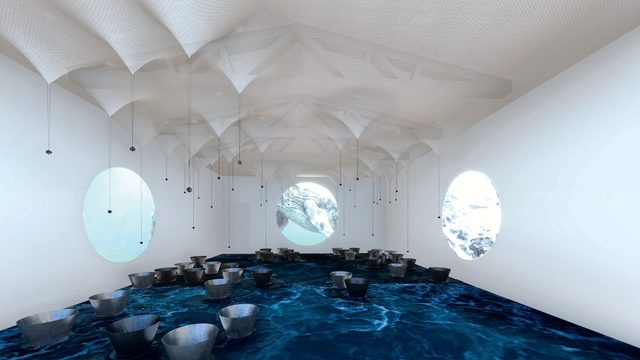
The national exhibition of Uruguay at the 2025 Venice Architecture Biennale, titled "53.86% Uruguay, Land of Water," explores the intrinsic relationship between architecture, territory, and water. Curated by architects Katia Sei Fong and Ken Sei Fong, along with visual artist Luis Sei Fong, the exhibition proposes that we may be entering the age of water, the "Hydrocene", and that the way humanity manages and conserves this resource will shape its future. In this context, the project highlights that Uruguay's maritime territory (53.86%) is larger than its land territory. Water, therefore, is not only a natural resource but a fundamental element of the country's history and culture, essential to its development.
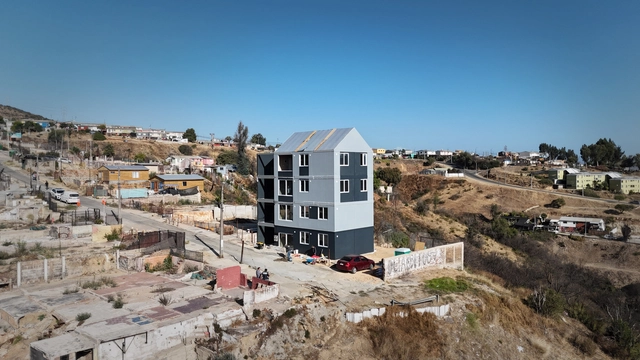
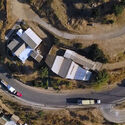
A year after the Viña del Mar mega-fire in Chile and with reconstruction efforts progressing at just 26%, the architecture firm ELEMENTAL and local authorities have begun construction on a prefabricated housing project in one of the residential neighborhoods most affected by the disaster. The project consists of a mid-density residential building with a modular steel structure, intended as a starting point for similar initiatives in response to what is now considered one of the most catastrophic events in Chile's recent history. As stated by Alejandro Aravena and the city's mayor, Macarena Ripamonti, the goal is for the technology and management model behind this project to set a precedent for delivering rapid and permanent housing solutions in emergency situations.
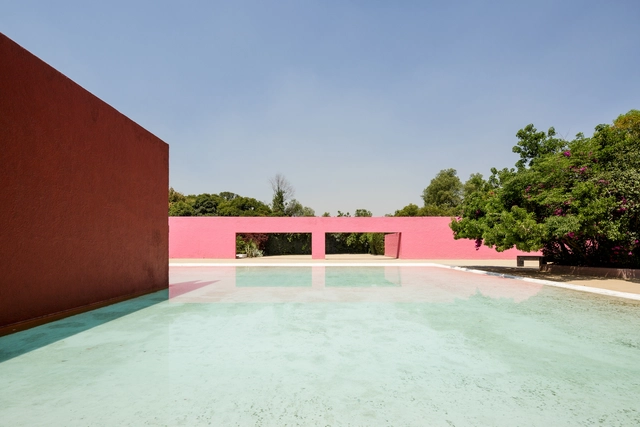
In October 2025, the Fernando Romero Foundation will officially open the doors of La Cuadra San Cristóbal, one of the late projects of Mexican architect and Pritzker Prize winnerLuis Barragán. The goal is to transform the architectural complex into a cultural campus open to the public, with a curatorial program focused on exploring the dynamic interaction between architecture and art.
The project, known as Cuadra San Cristóbal, was built between 1966 and 1968 and includes a house, a stables building, and auxiliary facilities such as the Fuente de los Amantes (Fountain of the Lovers). The complex showcases characteristic elements of Barragán's Latin American modernism, including his use of color and the integration of shadows, textures, and sounds into the experience of space.
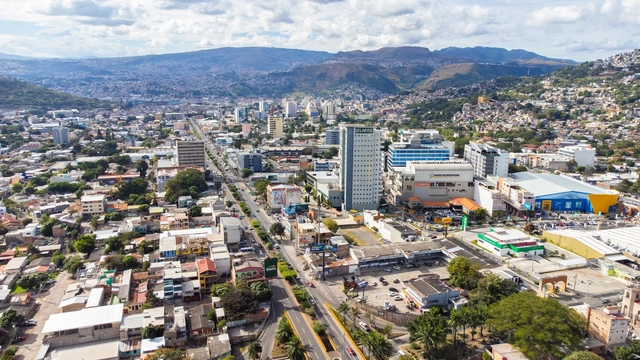
In 1975, Honduras was under a military regime that had been in power for over a decade, led at the time by General Juan Alberto Melgar Castro. During this period, Tegucigalpa underwent several big and unprecedented changes. The influx of people from various parts of the country due to rural migration transformed the city from a compact urban area into an expanding metropolis. This unexpected growth prompted the government to implement a municipal development and planning scheme, a project that would define the city's future and the evolution of its old town. This article was developed with the collaboration of the Honduran architect Lisandro Calderón, who specializes in Urban Planning and is currently a professor at the Central American Technological University (UNITEC), located in Tegucigalpa, Honduras.
Annually, ArchDaily's curatorial team undertakes a rigorous selection process to identify exemplary projects in Latin American residential architecture. The goal is to share these works of architecture with our audience and highlight and promote good practices within contemporary architecture. This meticulous effort focuses on identifying projects that stand out for their design and their positive impact on the environment, innovative use of materials and techniques, and ability to address current needs.
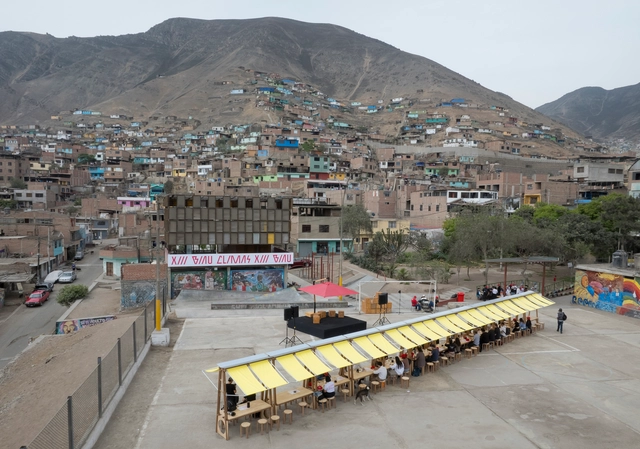
Local Comunal San Martín de Orúe, en La Balanza, Comas. Image Cortesía de BIAU
Amid the dynamism and speed that characterize our life in the contemporary world, especially concerning our cities and built environments, it is inevitable to recognize the importance of preserving spaces for pause and reflection, essential for addressing and discussing the key issues of architecture and urbanism that our society urgently needs today. The latest edition of the 13th Ibero-American Biennial of Architecture and Urbanism, held from December 2 to 6 in Lima, Peru, provided a unique gathering for such reflections and dialogues. Under the theme 'CLIMATES: Actions for the Good Living,' the event brought together architects and key figures from the field, who, during a week of roundtable discussions and conferences, focused on the challenges of global contemporary habitation, especially those shared between Spain and Latin America, thus serving as a bridge of knowledge between both contexts.
The Latin American Architecture Biennial (BAL), which has gained significant relevance in the contemporary architectural scene, will celebrate its ninth edition next year. This meeting gathers emerging Latin American architecture studios in Pamplona, Spain, to share their work, fostering dialogue and debate about the current state of the discipline, as well as acting as a bridge between the Latin American continent and the Spanish context. In this edition, Costa Rica will be the guest country, accompanied by Honduras, El Salvador, Panama, Guatemala, and Nicaragua. As part of this invitation, there will be an exhibition and specific seminars dedicated to analyzing the situation of architecture in these countries.
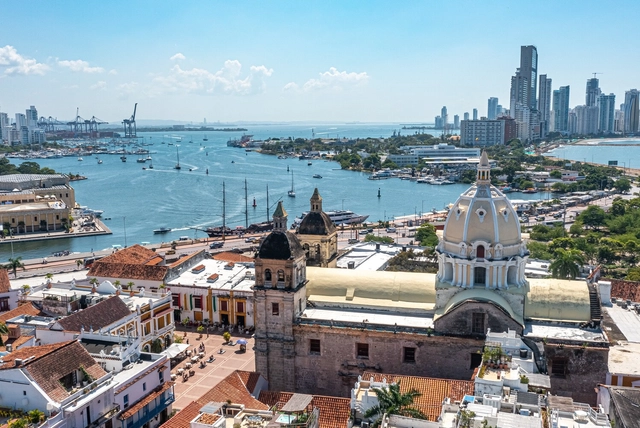
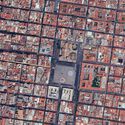
A look at most of the cities within Latin America reveals striking commonalities across countries, from Mexico down to Argentina: most cities have a well-defined area known as "El Centro" (The Center), anchored by a main plaza (Plaza Mayor), flanked by a church on one side and key buildings like the city hall on another. This is no coincidence, as it can be traced back to an urban planning system established during the Spanish colonization of the Americas in the 17th and 18th centuries. It gave standardized guidelines for city design across its viceroyalties. Unlike French and English colonies, Spanish settlements adhered to regulations that contributed to the emergence of a shared urban identity, with cities displaying similar spatial logic and architectural cohesion despite differing scales and contexts.
From November 20 to 23, São Paulo hosted the IV International Seminar on Favela Urbanization, bringing together discussions that bridged theory and practice to address interventions in these territories. Centered on Brazil’s realities, the seminar shed light on the political challenges and the struggle to recognize the potential of peripheral spaces. It also highlighted a shared issue across Latin America: the need for adequate funding to support transformative actions and the legitimization of these territories. Within this framework, the article underscores the critical role of high-quality public facilities in favelas and peripheral neighborhoods. These spaces not only provide access to opportunities but also foster community bonds, serving as essential hubs for social organization and collective efforts toward building a more inclusive future.