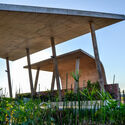
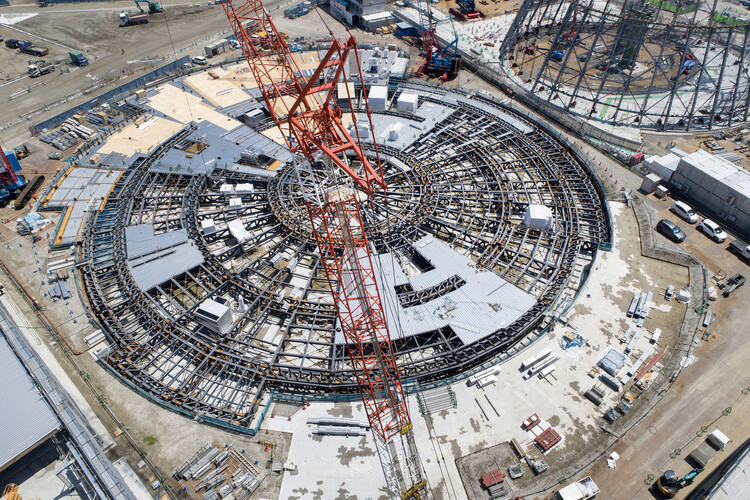
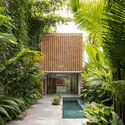
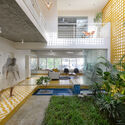
Osaka Expo 2025 Japan Pavilion / Nikken Sekkei. Image Courtesy of Ministry of Economy, Trade and Industry
In certain parts of the world, construction is still dominated by wet systems—concrete, masonry, and cementitious materials that are poured, cured, and fixed in place. While this has long been considered the norm in some south-east Asia countries, such as Singapore, Thailand, Malaysia, and China, in most of these regions, they typically share a common trend where labor is relatively inexpensive. This serves as one of the reasons to make concrete more easily available, as one of the typical downside of concrete is its intensive labour cost - this further differentiates concrete as a cheaper and more efficient material system to be building out of.
However, not enough considerations in the region are given to the sustainability aspect when using these wet construction materials,often overlooking the significant drawbacks of its material lifecycle and the difficulty to recycle it without downcycling - making it one of the more unsustainable materials available to be built out of.
Humid environments present some of the most complex challenges in architectural design. From the tropical monsoon season of Southeast Asia to the equatorial heat of Central Africa, these environments demand solutions that account for intense moisture, high temperatures, and the constant battle against mold, decay, and stagnation. Yet, for centuries, communities in these regions have developed architectural techniques that do not fight against humidity but instead work with it, leveraging local materials, climate-responsive design, and passive cooling techniques to create sustainable and livable spaces. By considering atmosphere as a sensory and climatic phenomenon, architects will craft spaces that are not only evocative but also responsive, adaptive, and sustainable.