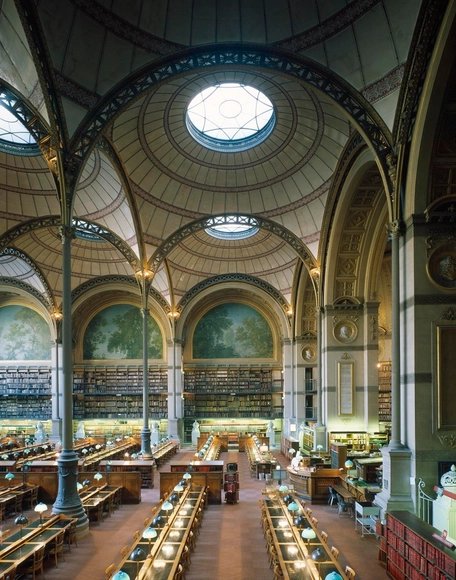
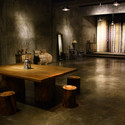
MoMA's upcoming exhibitionHenri Labrouste: Structure Brought to Light celebrates the impact of this 19th century architect on space, materials, luminosity and on great places of assembly. The exhibition will run from March 10th to June 24th, 2013 and will be the first solo exhibition of Labrouste's work in the United States.
Opening February 14, and on view until May 4, Yale School of Architecture‘s ‘White Cube, Green Maze: New Art Landscapes’ exhibition will examine emerging trends in museum design through six new art sites that share the common thread of moving beyond the traditional “white cube” gallery space, and that juxtapose the experience of culture, art, architecture, and landscape. Featuring newly commissioned photography of these sites by Iwan Baan, each site represents a unique expression of the ambitions and collaborations of patrons, architects, landscape architects, artists, and curators. For more information, please visit here.
Iwan Baan's name may ring a bell for all those following Hurricane Sandy's devastation across New York City and New Jersey's coast. The photographer's iconic photograph made headlines when it was featured on New York magazine's front page days after the storm, showing lower Manhattan in complete darkness, set against its vibrant counterpart uptown, as the United States' east coast was recovering from the extensive damage left in Sandy's wake. The image not only brings to mind the absolute helplessness that New York City faced during the storm, but also lends a hand in a social commentary that is notably pervasive in Baan's work. The Perry Rubenstein Gallery in Los Angeles will feature the photographer's work in a two-month exhibition entitled The Way We Live, honing in on the images that encapsulate the world of architecture, urbanism and human engagement.
Opening tomorrow, January 17, at the Danish Architecture Centre (DAC) in Copenhagen, Denmark, the ‘In Dialogue with the World’ exhibition, which runs until March 10, will show how architects today engage far beyond aesthetics when designing buildings. schmidt hammer lassen architects, along with Henning Larsen Architects, and ADEPT will invite visitors to listen to their accounts of what it is like to work in the field of architecture in the 21st century. With the title Give more, the schmidt hammer lassen architects’ part of the exhibition uses eight selected projects as examples of how buildings, aside from being beautiful, give more. More information after the break.
SFMoMA will highlight the legacy of Lebbeus Woods in an exhibition that will run from February 16 through June 2, 2013. It will include 75 works from the past 35 years of his career. Lebbeus Woods is often categorized as an architect, but always as an artist and visionary. His career has been filled with imaginative leaps through the concepts of space and form, exploring politics, society, ethics and the human condition. He was a great influence on architects, designers, filmmakers, writers and artists. The exhibition will celebrate his untimely death late last year and the breadth of influence that his work had on the art and design community.
Following the conclusion of David Chipperfield’s 2012 Venice Biennale, the British Pavilion has brought its investigations back to the UK to expand upon ten exceptional research projects that illustrate how architecture has shaped the culture and economy of countries around the world.
Should Amsterdam-style floating homes be built in London’s Docklands? Could the UK learn from Brazil’s successful identikit school-building program? Could Belfast be redeveloped by following a Berlin model? These are just some of the fascinating questions that will be addressed in a series of lectures, debates and events hosted by the Royal Institute of British Architects (RIBA) in collaboration with the British Council and the Architectural Association.
Mark your calendars for the following special events, which will run from February 26 through April 27, 2013.
Celebrating the ninetieth anniversary of the birth of Harry Seidler, the leading Australian architect of the twentieth century, the ‘Architecture, Art and Collaborative Design’ traveling exhibition will take place January 10-February 10 in Sofia, Bulgaria at the VIVACOM Art Hall. The exhibition traces Austrian-born Seidler’s key role in bringing Bauhaus principles to Australia and identifies his distinctive place and hand within and beyond modernist design methodology. The exhibition was developed by curator Vladimir Belogolovsky of Intercontinental Curatorial Project in New York with Penelope Seidler and Harry Seidler & Associates in Sydney and sponsored by Seidler Architectural Foundation. More information on the exhibition after the break.
Delicately crafted models by twelve students at Eindhoven University of Technologywill be the feature of an exhibit on Rudolf Olgiati called Die Sprache der Architektur (The Language of Architect). Oligiati was a Swiss Architect of the mid-20th century whose work has been attributed to the New Objectivist Movement. His work, which largely featured single family homes, brought a modernist aesthetic to the tradition of the mountainous Grisons of eastern Switzerland.
The Bartlett School of Architecture, UCL teamed up with Roca London Gallery to create the MArch Architecture Unit 22 end of year show – ‘Bartlett Architecture Dares to Care’, which is on display until December 18. Executed through the creation of Zoetropes, their study was focused on social and environmental sustainability, and the role architecture plays in preserving and empowering vulnerable communities. Each Zoetrope depicts the daily actions of an individual belonging to a vulnerable community. By designing for the everyday tasks, consideration is given to the role the built environment plays in protecting or helping them, rather than focusing purely on aesthetics. For more information, please visit here.
Opening at 6:00pm tomorrow at the Museum of Finnish Architecture, UNBUILT HELSINKI is an exhibition about the Unbuilt City and its inhabitants as part of the World Design Capital Helsinki 2012 program. Drawn from the museum’s archive and beyond, unrealized projects in Helsinki are studied by a team of researchers who generate new relationships with local resources in order to translate the projects into architectural models. Their findings and the narratives behind the buildings are displayed in an exhibition at the museum. The event is curated by Åbäke and Nene Tsuboi and will be up until February 24. For more information, please visit here.
Since 1851, World Fairs have offered glimpses into specific moments in time - giving us insight into what was once innovative, high-tech, and down-right radical. But the structures, the icons of each Fair, don't always stand the test of time - no matter their architectural pedigree. In Flushing Meadows Park, New York, for example, Modernist icon Philip Johnson's 1964 New York State Pavilion now stands neglected, overgrown in ivy. Mies van der Rohe's German Pavilion for the 1929 Barcelona Expo was promptly demolished (although eventually reconstructed).
On the other hand, the Eiffel Tower, although considered "vulgar" in its day (1889), was maintained because its height made it well-suited for emitting radio signals; it's now Paris' most important tourist attraction.
The fate of World Fair Structures is the theme of New York-based photographer, Jade Doskow, who has already shot 19 former World’s Fair sites. Take a peek at Doskow's images and find out how World Fair structures have fared, some better than others, after the break...
On display until February 3rd at the HangarBicocca in Milan, the ‘On Space Time Foam’ suspended art exhibit by Studio Tomas Saraceno is composed of a transparent surface accessible to visitors, hanging at a height of 20 metres and covering 400 square metres on three layers, for a total of 1,200 square metres. Known for his surprising structures that draw the public into extraordinary spatial and emotional experiences, the large soft and floating film welcomes visitors who will thus find themselves moving mid-air between the floor and the ceiling, earth and sky, and it compels them to lose their spatial coordinates. More images and architects’ description after the break.
The Museum of Modern Art in NYC is launching an exhibit called Tokyo 1955–1970: A New Avant-Garde, that investigates the transformation of Tokyo from a war-torn nation into an international center for arts, culture and commerce. The exhibition will run from November 18 through February 25, 2012 and includes over 200 works of various media including painting, sculpture, photography, architecture, drawings, graphic design, video and documentary film.
Intercontinental Curatorial Project, which promotes the role of architecture as the vital part of contemporary culture and life, presents its ongoing traveling exhibition Colombia: Transformed. The event is to be shown November 8-9 as part of the Dialogues with the Informal City: The Case of Latin America and the Caribbean symposium. This interdisciplinary symposium seeks to connect a range of fundamental themes affecting the current conditions and future of Latin America’s growing informal cities and by extension the rising global urban population.The event will take place at the Jorge M. Perez Architecture Center at the University of Miami’s School of Architecture. The exhibition is co-sponsored by the University’s Center for Latin American Studies and the School of Architecture. For more information, please visit here.
Taking place October 26-December 2, the White Mountain Chilean Contemporary Architecture exhibition is composed of a selection of relevant works. Put on by Aedes Berlin, the event highlights the richness of the recent projects is originated and developed within its landscape. The atmospheric design of the exhibition demonstrates this significant creative moment of the Chilean buildings, often described as the continent’s most interesting today. For more information, please visit here.
Building: Inside Studio Gang Architects, is the first solo exhibition dedicated to the work of Studio Gang, which will be on view at the Art Institute of Chicago until February 24, 2013. The show immerses visitors in the energy of the studio’s creative process and the stream of ideas that connects its growing body of work. More images and information on the exhibition after the break.
Designed by TAAT (Theatre as Architecture, Architecture as Theatre) and exhibited at the World Horticultural Expo 2012, Khor I is a specific challenge to perform a play without any guidance or introduction. The dramatic situation is simply available and can be ‘filled-in’ and approached freely. The theatre installation represents a common ground between theatre, architecture and the visual arts with its monumental quality. More images and architects’ description after the break.