This past Fall, ROMA Design Group proudly announced the completion of the Martin Luther King Jr. National Memorial in Washington D.C. In 2000, ROMA won the international design competition among nearly 1,000 entries. ROMA Design Group worked for several years to develop the design. The memorial has now been built and was officially dedicated by President Obama on October 16, 2011.
Architect: ROMA Design Group Location: Washington D.C., USA Illustrations: Christopher Grubbs Photographs: Courtesy of ROMA Design Group
https://www.archdaily.com/200438/martin-luther-king-jr-memorial-roma-design-groupAmber P
Earlier this month, a Washington D.C District chapter opened their doors to the streets near Chinatown and the Penn Quarter. The office joined other East Coast chapters in the movement promoting visibility, transparency and sustainability in architecture.
Over 500 people from all across the country and around the world participated in the National Ideas Competition for the Washington Monument Grounds. From a field of twenty-four semifinalists, a distinguished jury chose six top ideas. Now it is the public’s turn to choose the top two People’s Choice winners. More information on the finalists and their proposals after the break.
USA Today has put together a list of city neighborhoods which are satiated with activity, areas which offer a “great slice of urban life.” These districts trend from the urban vicinity to its very core, each in itself exemplifying the revitalization of the American city. The list includes regions which have been influenced by deliberate urban revitalization projects, such as High Line Park in Chelsea; while other neighborhoods have experienced an influx of a younger populace which has contributed to its growth, such as Lawrenceville in Pittsburgh.
See the 10 Up and Coming Urban Neighborhoods after the break.
This was the third time we attended the event (after 2009 in Buenos Aires and 2010 in New York) and it was a special evening, not only because of the renowned architects attending the event, but also for the presenting speech by President Barack Obama. Obama, a friend of the Pritzker family, delivered a short but interesting speech to Souto de Moura and the architects. Obama’s interest in architecture goes way back as we’ve heard him state that he thought he could be an architect, but as he said at the speech “I expected to be more creative than I turned out, so I had to go into politics instead”.
It’s worth mentioning that Obama referred to the Pritzker Prize as the Nobel of architecture, a common comparison that puts the importance of this recognition in context.
After several mentions to architecture, his hometown Chicago, Mies (his campaign HQ was in a Mies building), Louis Sullivan, Frank Lloyd Wright, and Jefferson’s Monticello, he mentioned that architecture is about “creating buildings and spaces that inspire us, that help us do our jobs, that bring us together, and that become, at their best, works of art that we can move through and live in. And in the end, that’s why architecture can be considered the most democratic of art forms“.
About Souto de Moura’s work he mentioned that it was “effortless and beautiful”, and he highlighted the fact that the Braga Stadium was a democratic building, as he not only served the audience but people on the outside.
After Obama and Lord Palumbo (chairman of the Pritzker jury) Eduardo Souto de Moura accepted his recognition, and said something very interesting that made me understand contemporary Portuguese architecture. He developed his work during the 1974 revolution in Portugal, after which the country required to give housing to millions of people. At that time post modernism was starting strong in the country, but that wasn´t the way to do housing (with columns and arches), which led to a late modernism that we see on his works, which in my opinion became a legacy to the new generation of Portuguese architects. More photos after the break:
Gustafson Guthrie Nichol (GGN) announced the beginning of construction of the CityCenterDC development by Hines|Archstone in downtown Washington, DC. A new mixed-use development located on the 10-acre site of the former convention center, CityCenterDC is one of the largest downtown development projects currently underway in any U.S. city. Gustafson Guthrie Nichol participated in developing the master plan for the site with lead architect Foster + Partners, and acted as lead landscape architect, working with DC-based Lee and Associates. Additional members of the design team include DC-based Shalom Baranes Associates, serving as associate master plan architect, project Architect of Record, and lead designer of the residential rental buildings.
Construction commenced on March 23, 2011, and is expected to reach completion by the fourth quarter of 2013. The project includes the development of Northwest Park, a lively addition to downtown DC, the creation of a Central Plaza, as well as dramatic terraces with green roofs and gardens incorporated into all the buildings. More images and description after the break.
Exploring modern design and a technological future, the 1930s World Fair’s held in Chicago, San Diego, Cleveland, Dallas, and New York featured architects and industrial designers such as Raymond Loewy, Norman Bel Geddes, Henry Dreyfuss, and Walter Dorwin Teague. A modern, technological tomorrow unlike anything seen before, the World Fair’s presented visions of the future including designs for the cities and houses of tomorrow with a lifestyle of modern furnishings which were viewed by tens of million of visitors.
Designing Tomorrow: America’s World’s Fairs of the 1930s exhibition is currently on display at the National Building Museum in Washington DC thru July 10, 2011. Building models, architectural remnants, drawings, paintings, prints, furniture, along with period film footage are all included within the exhibit.
The U.S. Department of Energy just announced that the West Potomac Park, adjacent to the National Mall between the Lincoln and Jefferson Memorials will be hosting the 2011 Solar Decathlon. The event’s permit for the National Mall, the launching pad for the largest solar competition in the world, had been revoked in mid January creating a lot of disruption for the 20 collegiate Solar Decathlon teams who had put over 18 months of work in preparation for the event.
Here is our previous coverage of the Solar Decathlon.
The 20 collegiate teams chosen for the 2011 Solar Decathlon headed to Orlando, Florida last week for the International Builders’ Show where they met with media, exhibited scaled models of their current designs, and had their Design Drawings reviewed – the last stages of preparation, feedback, and red-flags prior to the September assembly at the National Mall in Washington DC.
In a strange turn of events, the National Park Service and Department of Energy decided to simultaneously announce last week that the Solar Decathlon would not be hosted at the National Mall. Contestants were blindsided by the announcement to relocate this years U.S. Department of Energy Solar Decathlon 2011 competition. The launching pad for the largest solar competition in the world, where contestants are educating the general public about sustainable living and further are held fiscally responsible under competition rules for maintaining and restoring their respective sites to their natural state following the exhibition, is apparently not good for sustainability.
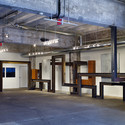
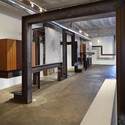
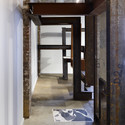
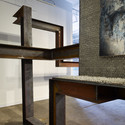
The Longview Gallery in Washington DC invited David Jameson Architect to design an installation that investigates the relationship of art and architecture. The gallery space is housed next to the DC Convention Center in the shell of a 1930’s auto repair garage. Conceived as a spatial armature, Stalling Detritus, as the installation is called, creates a gallery within the gallery by weaving steel beam scraps through space that react to the topography of the concrete structure.
Architects:David Jameson Architect, Inc. Location: 1234 9th St NW Washington, DC, USA Principal: David Jameson Project Architect: Ron Southwick Contractor: Rockville Iron Works Inc Project Year: 2010 Photographs: Alan Karchmer Photography
Welcome to the Architecture City Guide series. Here at ArchDaily we thought this series could especially be put to use during the upcoming holiday season. Many will be traveling to see family, having family visit, or taking a New Year’s vacation to a new city. Here is a small City Guide list, starting with Washington D.C.
We want to hear from you, share with us your City Guide list for buildings in Washington D.C. More cities to come, so be sure to check back.
Follow the break for our Washington D.C. list and a corresponding map!
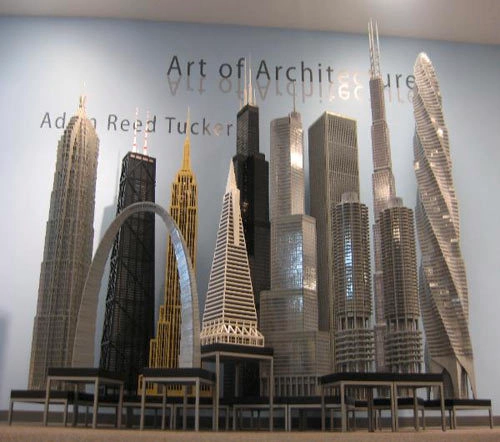
Growing up, LEGO were a staple of most children’s playtime activities to create anything from a house to an entire city for hours at a time. The blocks were so captivating that it seems that even as we outgrow our childhood years, we can never outgrow the toys. Previously, we’ve featured projects that have shown James May’s LEGO addiction…his actual house is built from LEGOs! Yet, May isn’t the only one to still show an interest in the children toys – architect Adam Reed Tuckerhas created 15 large scale buildings from around the world just using the blocks. The buildings are the focal point of the exhibition LEGO® Architecture: Towering Ambition at the National Building Museum in Washington, DC.
Digital submissions must be registered online at www.aiadc.com and received at the offices of the Washington Chapter/AIA between April 15 and June 30, 2010. Seen at Death by Architecture.
Czech architects Chalupa Architekti shared with us their winning proposal for the competition of the new Embassy of Czech Republic in Washington DC, USA.
More images and architect’s description after the break.
The Smithsonian Institute has announced the finalists for the new National Museum of African American History and Culture in Washington D.C. The museum will be located at the end of the Washington Mall, being the latest addition to this location. The design concepts will be on show at the castle building until April 6. The, a jury will select a winner. The museum will open in 2015, at a cost of 500 million dollars.