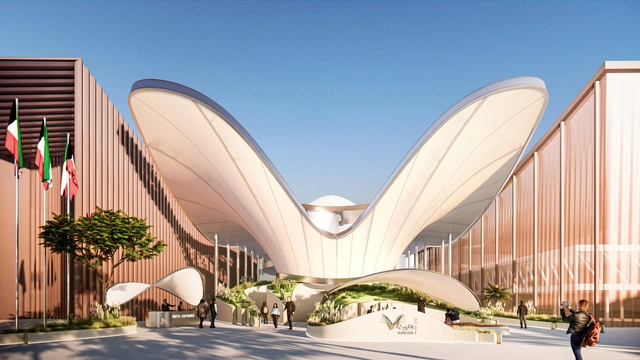
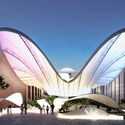
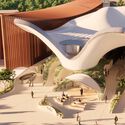
The State of Kuwait has revealed the design of the upcoming Kuwait Pavilion to take shape at World Expo 2025 in Osaka. Designed by architectural firm LAVA (Laboratory for Visionary Architecture), the temporary structure is envisioned as a “Visionary Lighthouse” representing Kuwait’s embrace of Arab cultures, arts, and social works. The pavilion, developed with main partner and contractor NUSSLI, also offers a response to the exhibition’s overarching theme, "Designing Future Society for our Lives", striving to strengthen the relationship between Kuwait and Japan and foster conversations about visions of a sustainable future.
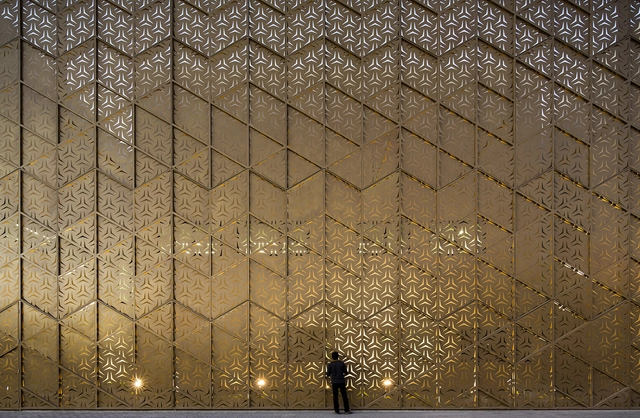
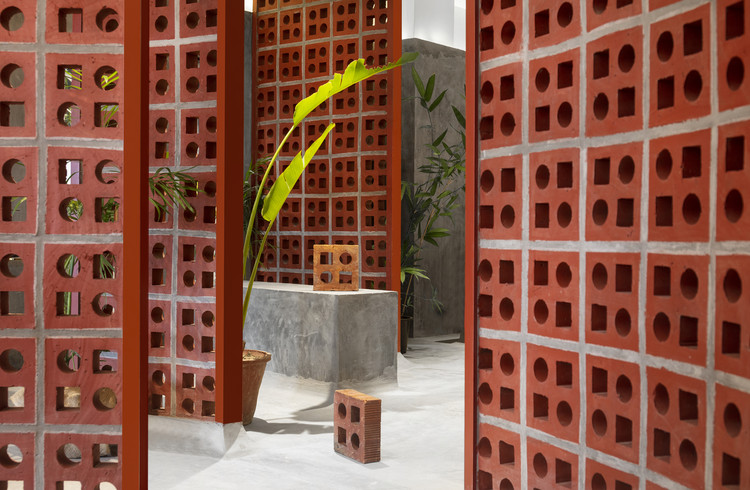
For centuries, arid environments have solved the problem of light, privacy, and heat through a statement architectural feature of Islamic and Arab architecture, the mashrabiya. Crafted from geometric patterns traditionally made from short lengths of turned wood, the mashrabiya features lattice-like patterns that form large areas. Traditionally, it was used to catch wind and offer passive cooling in the dry Middle Eastern desert heat. Frequently used on the side street of a built structure, water jars, and basins were placed inside it to activate evaporative cooling. The cool air from the street would pass through the wooden screen, providing air movement for the occupants.
Similar to the Indian jali, the vernacular language also offers a playful experience with daylight while still maintaining a certain degree of privacy. Traced back to Ottoman origins, the perforated screens protected occupants’ from the sun while simultaneously letting daylight through in calculated doses. Although the mashrabiya was a statement in arab and Islamic architecture languages, it wasn’t until 1987 that the archetypal element began appearing with a revised contemporary application.
Sumaya Dabbagh, the founder of Dabbagh Architects, based in the UAE, stands at the forefront of architectural innovation with a focus on identity and connection to place. Her recent participation in the Sharjah Architecture Triennial’s second edition “Earth to Earth" is a showcase of cumulative ideas that Dabbagh Architects has been fostering through their projects. Onsite in Sharjah, ArchDaily had the chance to speak to the architect about her exploration at the Triennial, as well as her broader architecture practice and its impact on the Global South.
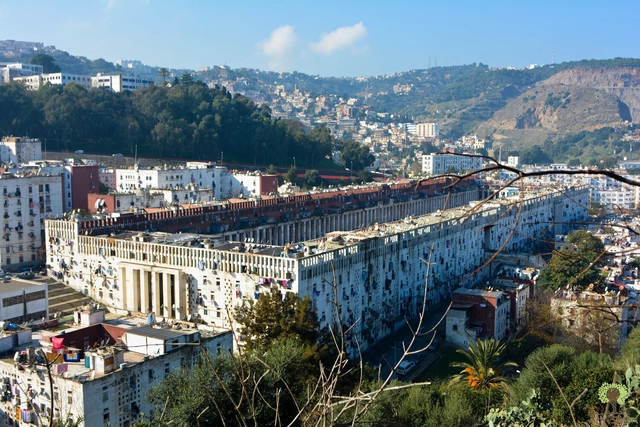
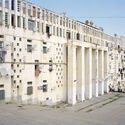
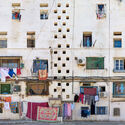
The Climat de France is a French colonial social housing project in Algeria designed by Fernand Pouillon and currently renamed Oued Koriche. Located approximately 8km west of the country’s capital, Algiers, it was built from 1954 to 1957, right in the middle of the Algerian War of Independence. The project has several buildings with different scales. Its most prominent structure is a large rectangular building that houses 3000 dwellings, along with a spacious interior square similar to a Roman forum and exterior windows inspired by the mosaics found in Islamic architecture.
This social housing scheme has a complex history, involving the integration of Algerians into the French lifestyle, the use of modern architecture to challenge traditional Muslim ways of living, and the transformation of its collective square into a site of protest and rebellion.
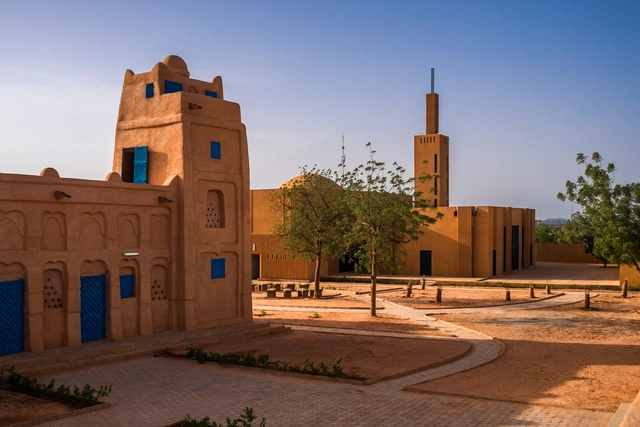
Sub-Saharan Africa is home to an enormous number of religious adherents – within which there is extraordinary diversity in religious expression. Iconic buildings serving a religious purpose are found throughout the continent, such as The Cathedral Basilica of the Holy Family in central Nairobi or the Hare Krishna Temple in South Africa. What is evident is that architecture that hosts religious gatherings makes up a key part of the urban fabric of sub-Saharan African cities and that in a lot of cases, religious structures go against the grain – leaving aside or tweaking classical models in favor of a unique architectural approach.
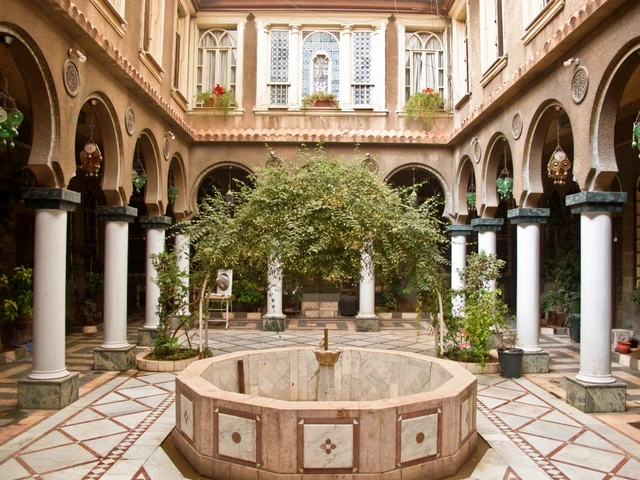
Beit Rumman Hotel, Damascus. Image via Tumblr Account syrian-courtyard
We have seen in recent residential projects the need for bringing the outdoors inside, whether it's through green walls, biophilic designs, or interior courtyards, especially in countries with dry and hot climates. When it comes to countries of the Arab world, creating these outdoor-inspired inner spaces is a lot more than just bringing in some sunlight and fresh air, it is an architectural expression of a rich culture that transcended generations and inspired nations beyond their borders. In this article, we will explore how cultural and social norms influenced the creation of traditional courtyard houses in Arabian countries and how their unique architectural features were reimagined in modern contexts.
The Islamic Architecture style has a diverse history, spanning over a millennium, stretching from Western Africa to Europe to Eastern Asia. Beginning in early 7th century Arabia, this form of architecture emerged with the rise of the Islamic civilization. In fact, Al Masjid Al Nabawi, the first Mosque to ever be constructed was built in 622, in Medina, Saudi Arabia. Moreover, early Islamic architecture was influenced by the pre-existing styles around the region, such as Roman, Byzantine, and Persian qualities.
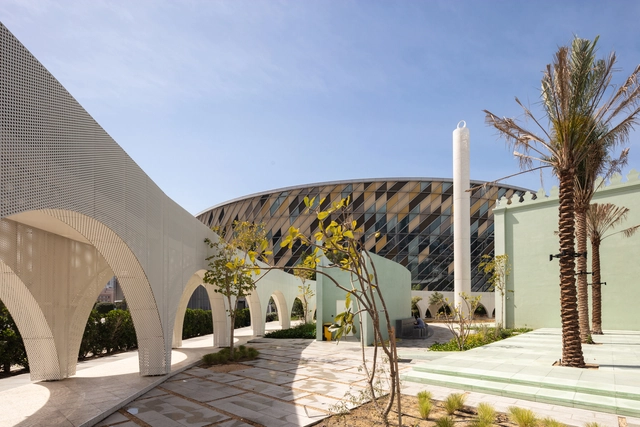
Today, Islamic architecture is known for its acute attention to detail, craftsmanship, and its spiritual symbolism. Furthermore, as color plays an essential role in architecture, influencing the emotional experience of the space, different colors have been utilized over the years in Islamic Architecture to evoke certain meanings. In Islamic Architecture, colors hold significant spiritual symbolism, reflecting the values and beliefs of the Islamic faith. Four core colors, Green, Blue, Gold, and White, are each used to convey various cultural, religious, and symbolic meanings.
Read on to discover the use of these colors in various Islamic architectural icons around the world.
There is often an intricate relationship between architecture and the environment. Each part of the world has defined its own architectural techniques based on its unique climatic conditions. However, environmental concerns in the 21st century provoked new techniques, implementing solutions to preserve natural resources and provide thermal comfort. While some opted for a futuristic approach with mechanical and technologically-advanced solutions, others decided to go back in time and explore how civilizations protected their people, architecture, and environment when they had nothing else to resort to but the environment itself. In this article, we look at how Musharrabiyas found their way back into modern-day architecture as significant vernacular features.
The mosque; the Islamic holy place of prayer, carries a distinct structural characteristic and identity. It is a serene and spiritual architecture that brings individuals closer to their faith and divine entity. Prophet Muhammad's original house in Medina (in present-day Saudi Arabia) is believed to be the first place of prayer, and served as a model for early mosque architecture; a mud-brick structure with living quarters on one side of an enclosed rectangular courtyard. Soon after, the allocation of open spaces in the center of towns where Muslims could gather and pray became more frequent, resulting in several spaces of worship with a universal spatial characteristic: their orientation towards Mecca.
The design process of the mosque started with a single enclosed geometric form, reinforcing the idea of spirituality and seclusion. Soon after, this simple spatial prototype evolved into the first formal hypostyle mosque, known for its vast prayer hall and series or arcades. Variations of this model saw the first mosque in Medina, known as the Quba Mosque (622 CE), the Kairouan Mosque in Tunis (670 CE), and the Umayyad mosque in Damascus (715 CE), some of which incorporated column details from ancient Greek and Roman architecture. However, the role of mosques evolved throughout the years from just a place of worship to an architecture that helps in re-establishing the values of Islam and offers contributions to society, including educational, civic, and ceremonial.
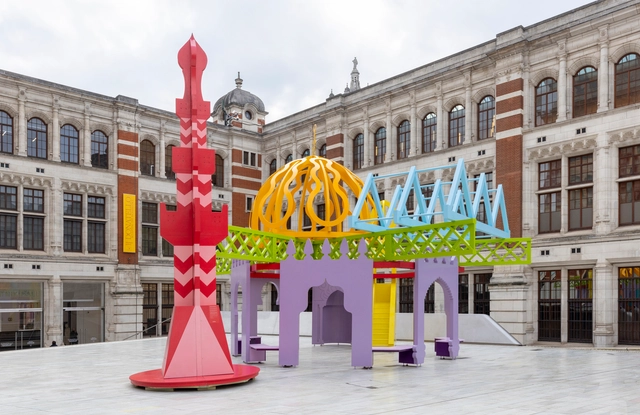
Ramadan Pavilion. Image Courtesy of Victoria & Albert Museum
Ramadan Tent Project and V&A present the Ramadan Pavilion 2023, an architectural installation inspired by the holy month of Ramadan, which starts today. The Ramadan Pavilion 2023 is designed by architect Shahed Saleem and will be open to the public at the Exhibition Road Courtyard of the V&A South Kensington until May 1, 2023. As part of the annual festival, the pavilion is accompanied by a series of events, performances, and workshops curated by the Ramadan Tent Project.
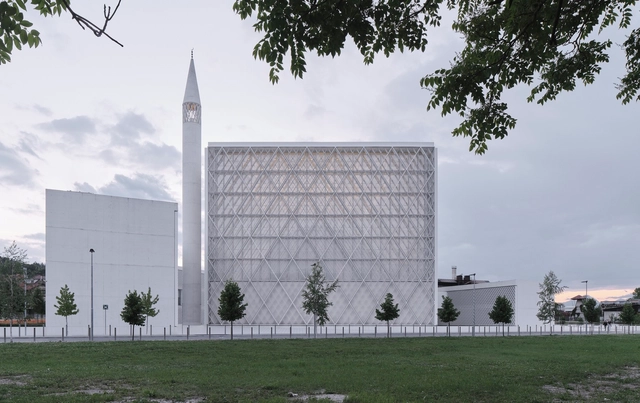
Under the theme of "Mosque: a cross-cultural building", the 4th cycle of the Abdullatif Alfozan Award for Mosque Architecture (2020-2023) has announced its 5 winning projects hailing from Australia, Turkey, Serbia, Slovenia, and Mozambique. The award ceremony took place at the Riyadh National Museum on March 5th, 2023, followed by a 2-day architectural seminar in which the architects explained the design process behind their winning projects.
Looking into mosques between the past, present, and future, the selection took into account each project's contextuality, privacy, its religious and architectural significance, and contribution to the community. Over 200 mosque were submitted from across the world, narrowed down to a shortlist of 22 projects. The five winning mosques, however, were commended for looking beyond common mosque typologies, as they explored the importance of feeling within a religious space, their value as "urban communication tools", and how their architectural languages are re-establishing the values of the religion.
The Islamic Arts Biennale re-imagines the Western Hajj Terminal at King Abdulaziz Airport in Jeddah, Saudi Arabia, as a cultural space to create an evocative journey to explore Islamic heritage. The terminal, designed by Skidmore, Owings & Merrill and a winner of the 1983 Aga Khan Award, will be extended and complemented to create the setting for the event. Through the contributions of over 60 artists from over 20 countries, the biennale aims to become a platform to explore and reflect the diversity of the Muslim experience worldwide. Themed Awwal Bait, or The First House, the event intertwines commissioned works with never-before exhibited historical artifacts to convey a holistic perspective of the Islamic arts. The Biennale, curated by Sumayya Vally, now in its inaugural edition, will be open from January 2023 to April 2023.
Organized by the Abdullatif Alfozan Award for Mosque Architecture and the College of Architecture at Kuwait University, the 3rd International Conference on Mosque Architecture was held in Kuwait on 14-16 November 2022. Under the theme of “Mosque: a cross cultural building,” 101 architects participated in this year’s edition, showcasing their state-of-the-art designs and how they reimagined religious buildings in a more contemporary context, taking into account the importance of community, privacy, its religious significance, and the environment.
Syrian architects Marwa Al-Sabouni and Ghassan Jansiz bring an Arabic-inspired architectural element to the seafront of Hove as part of this year’s Brighton Festival. The temporary pavilion is built in the shape of the traditional arcade called The Riwaq. Conceived as a place that brings people together, the installation will host free cultural and community events, all organized as part of England’s largest annual multi-arts festival. Established in 1967, the Brighton Festival celebrates music, theatre, dance, art, film, literature, debate, and outdoor events in various locations across Brighton, Hove, and East Sussex.
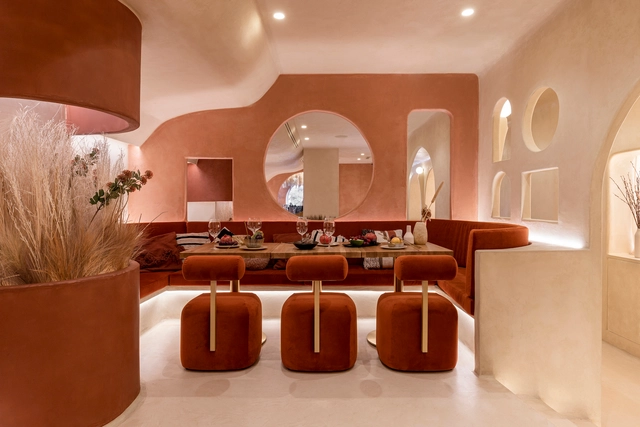
"The details are not the details. They make the design." – Charles Eames. Creating attractive spaces that anticipate the needs of users relies on several factors: scale, circulation, functionality, and comfort. However, the past few decades have proved that the visual appeal of a project is also greatly important, and can make or break the interior space. In this interior focus, we will explore the aesthetic side of interior design, looking at popular styles across the world and how architects and designers use elements such as color, furniture, accessories, and finishes to define their spatial identity.
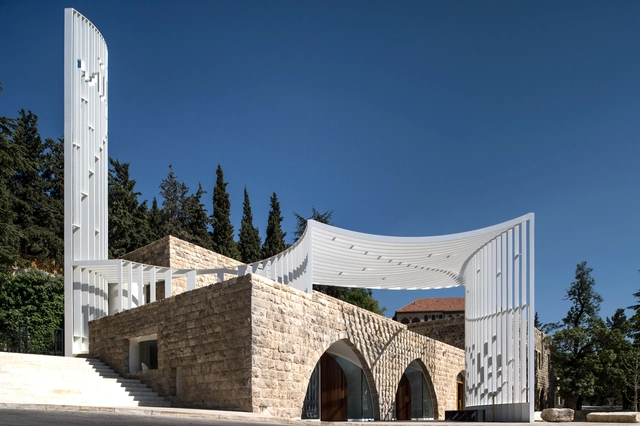
Amir Shakib Arslan Mosque / L.E.FT Architects. Image Courtesy of Abdullatif Alfozan Award for Mosque Architecture
The Abdullatif Alfozan Award for Mosque Architecture has honored seven awarded mosques in its third cycle under the theme "Mosque architecture in the twenty-first century", evaluating their unique architectural concepts as well its connectivity with local communities.
https://www.archdaily.com/974298/projects-in-saudi-arabia-lebanon-and-indonesia-among-the-winners-of-the-iii-abdullatif-alfozan-award-for-mosque-architectureArchDaily Team
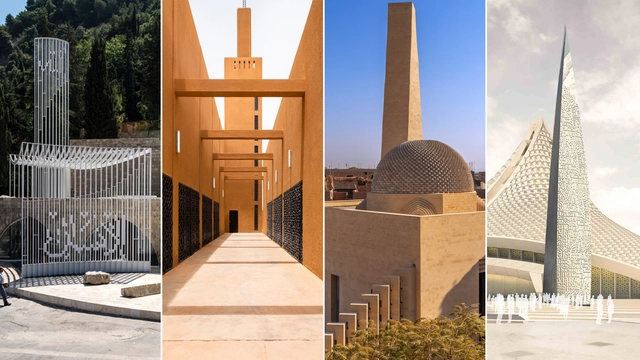
Islamic architecture has long been acknowledged as one of the most significant and influential typologies that translates the religion's core teachings and beliefs into structures. One of the most striking characteristics of architecture in the Islamic world is the focus on interior spaces. Whether it is a methodical organization of interior layouts to make use of natural light and ventilation, or the intricate detailing of ornamentation through carvings and paintings, the contrast between exterior and interior is palpable. However, one particular architectural feature defies the norms of modest facades, and stands as a strong visual statement of the presence of Islam. The minaret's distinctive structure strengthened its presence as a focal point, guiding people towards the religion's holiest space. In this article we will explore the reason behind the use of minarets and how its function has evolved culturally and architecturally.
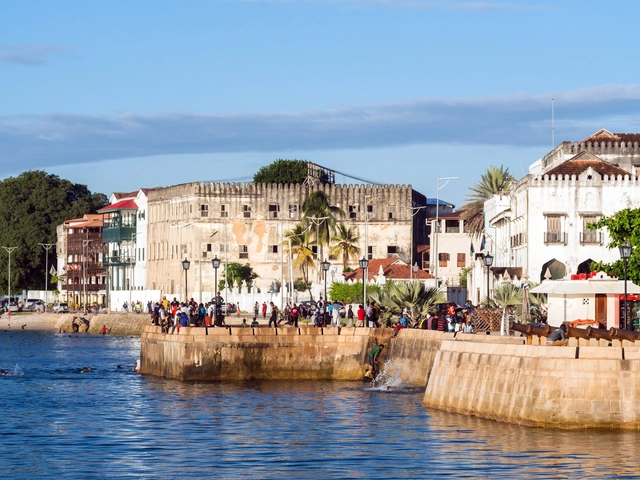
The African continent has been - throughout history – a key player in the ever-evolving story of human migration. Cultures and customs have been shared, adapted, and re-imagined as a result of this movement of populaces, and architectural styles are no exception. In a way, the varied architecture present in Africa is a lens one can look at to understand the intricacies of migration. Present on the continent are ancient indigenous and building typologies born out of the organic assimilation of cultures. Also present are remnants of colonial architecture, a legacy not of voluntary migration, but of forced colonial imposition.













_(14783070935).jpg?1628520318 "Courtesy of Wikimedia Commons (CC BY-SA 4.0)")
.jpg?1628520094 "Iwan . Image Courtesy of Wikimedia Commons (CC BY-SA 4.0)")















_2.jpg?1653224708&format=webp&width=640&height=580)
.jpg?1653224549 "© Jim Stephenson")
.jpg?1653224741 "© Jim Stephenson")
.jpg?1653224579 "© Jim Stephenson")
.jpg?1653224564 "© Jim Stephenson")
_2.jpg?1653224708)