With our Building of the Year Awards entering our final days of voting, today’s selection of previously featured hotels includes the category winner for last year’s Awards. Check the complete selection after the break.
The Yas Hotel / Asymptote The Yas Hotel, a 500-room, 85,000-square-meter complex, is one of the main architectural features of the ambitious 36-billion-dollar Yas Marina development and accompanying Formula 1 raceway circuit in Abu Dhabi, UAE (read more…)
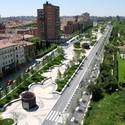
In 2005, an invited international competition was announced for a design of the reclaimed area above a tunnel holding a section of the M30 ring motorway immediately adjacent to the old city centre. The team proposed to resolve the urban situation exclusively by means of landscape architecture, and were the winning submission. The design is founded on the idea »3 + 30« – a concept which proposes dividing the 80 hectare urban development into a trilogy of initial strategic projects that establish a basic structure which then serves as a solid foundation for a number of further projects, initiated in part by the municipality as well as by private investors and residents.
London based architects, mossessian & partners, have shared with us their recent work, Al Barahat Square in the Musheireb development in Doha, Qatar. Additional images and a press release for this new civic space after the jump.
The team of BIG + TNT Nuuk + Ramboll Nuuk + Arkitekti have won the competition to design the new National Gallery of Greenland in the country’s capital Nuuk, among invited proposals totaling 6 Nordic architects. More images and complete press release after the break.
Evgeny Didorenko shared with us his project whose aim of a landmark was not to create a monument to the power of the industrial age and conquest of nature, but rather a monument to nature. Doing so would acknowledge the generous gifts nature has given us that was produced centuries and even millenniums ago. Brown coal – one of it’s gifts. More images and architect’s description after the break.
You can now see almost 40,000 photos in our Flickr Pool! And here’s our 33rd selection of it. As always, remember you can submit your own photo here, and don’t forget to follow us through Twitter and our Facebook Fan Page to find many more features.
The photo above was taken by d.teil in Berlin, Germany. Check the other four after the break.
Browsing Lapham’s Quarterly, I came upon an interesting little article under the heading, “Practice and Theory.” Then I noticed the date, c. 25 BC, Rome—hardly current for online content. I soon realized I was reading a passage from Vitruvius’ On Architecture, one of those texts in the canon of western architecture that I should be familiar with—or at the very least know about. The former I make not claims to. I’m afraid the latter is more the case.
This might come as a shock, but I have not actually read his entire ten-volume treatise. On another note of disappointment, the man’s life remains obscure and I have no intention of making it any less so here. Be that as it may, the passage reproduced here seems relevant in this era of increasing specialization, professional insularity, technology- and theory-driven practices, and unstable business models.
President Obama in his State of the Union address shared plans for making American businesses more energy efficient. Focusing on investing in innovative clean energy technologies, the ‘Better Buildings’ initiative aims to increase energy efficiency in commercial buildings by 20 percent over the next decade. Building on his other contributions, the American Recovery and Reinvestment Act and proposed “HOMESTAR” legislation, this series of incentives would hope to propel private sector investment to upgrade offices, stores, schools and other municipal buildings, universities, hospitals, and other commercial buildings.
YAJ Architects present a proposal for the future of industrial buildings in an atmosphere where environmental and sustainable practices are vital, yet largely focus on the construction of housing and offices. This design for the Future Train Depot focuses on a near zero energy performance by using ground water heating and cooling, solar panels, and sensor-driven natural ventilation.
Nominations are invited for the 2011 Harleston Parker Medal, which is presented to “such architects as shall have, in the opinion of the Boston Society of Architects…completed the erection for any private citizen, association, corporation or public authority, the most beautiful piece of architecture, building, monument or structure within the limits of the City of Boston or of the Metropolitan Parks District”.
Rotterdam-based office for urban design and landscape architecture West 8, in collaboration withSener & Gestec, have designed this entry for the Valencia Central Park Competition. Their proposal achieved a place on the competition shortlist. The design presented here is a concept for Parque Central inspired by the Valencian tradition of solid narrative and poetry.
More images and description of the project after the break.
David Tribby, of David Tribby Photography has spent the past few years documenting the abandoned and decaying architecture of Gary, Indiana and has shared his collection of work with us. Considering his work, Gary’s past and Gary’s present allows us to discuss a broader topic, the possible outcomes for abandoned architecture and their role in today’s urban centers. More of David Tribby’s photographs and a brief narrative after the break.
Yushang Zhang, Rajiv Sewtahal, Riemer Postmaand Qianqian Cai (with studio tutor Alexander Sverdlov, at The Why Factory of professor Winy Maas (MVRDV) at the TU Delft) shared with us their project, “Vertical Village: A Sustainable Way of Village-style Living”, which was awarded the first prize in the d3 Housing Tomorrow 2011 Competition. The competition called for transformative solutions that advanced sustainable thought, building performance, and social interaction through the study of intrinsic environmental geometries, social behaviors, urban implications, and programmatic flows.
The d3 Housing Tomorrow competition assumes that architecture does not simply form, but rather perform various functions beyond those conventionally associated with residential buildings. More images and architects’ description after the break.
Las Vegas is our destination for the Architecture City Guide series this week. Some of the most famous hotels and casinos grace the streets of Las Vegas, we’ve included those and much more. We want to hear from you, so take a minute to add your favorite can’t miss buildings in Las Vegas in our comment section below.
The Architecture City Guide: Las Vegas list and corresponding map after the break!
The Center for the Promotion of Science proposal by Zürich based architecture studio Dürig AG is based on the concept of a New Belgrade composed of an orthogonal grid of a unified structural system that embraces rationality and clarity. The urban plan of the composition is to create defined individual building segments within the subdivided block of nine distinct segments. Within this development, Dürig AG has designed a Scientific Research Institute of which the Center for the Promotion of Science is an integral part.
On our sixth selection of previously featured interiors we are still looking back at projects published on 2009. Check them all after the break.
Bank in Donoratico / Massimo Mariani The project concerns the redesign of a building at Donoratico (in Livorno) located next the head office of the bank “Banca di Credito Cooperativo di Castagneto Carducci” (also designed by architect Mariani in 2002). The building is on two levels (read more…)
Football is one of the best vehicles for social change (not to mention it’s fun to play). As fans of social change AND fun, Architecture for Humanity, Nike, and Fu.De (Football for Development) have teamed up to host a design competition for a prototype football, education, and health center for Liga FOS — a project that promotes social development through sport in vulnerable Buenos Aires suburbs.