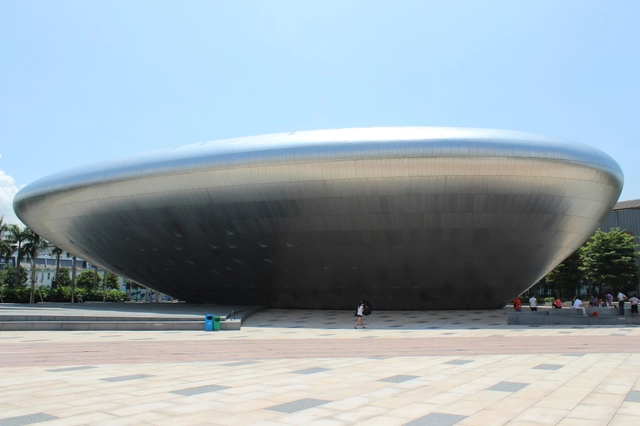
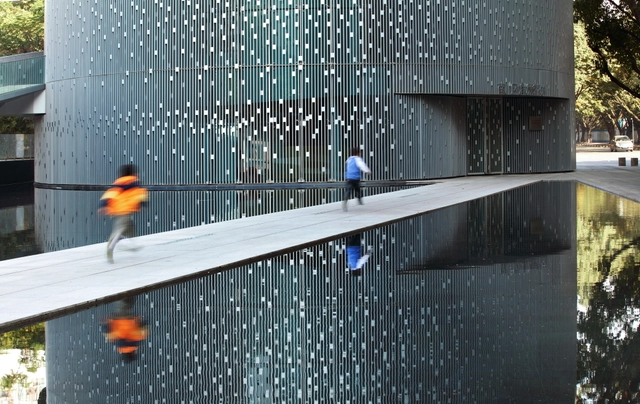
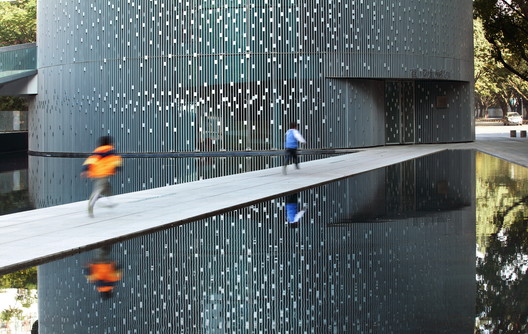
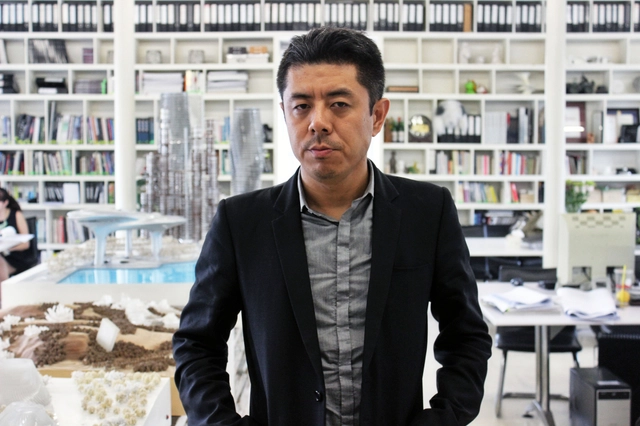
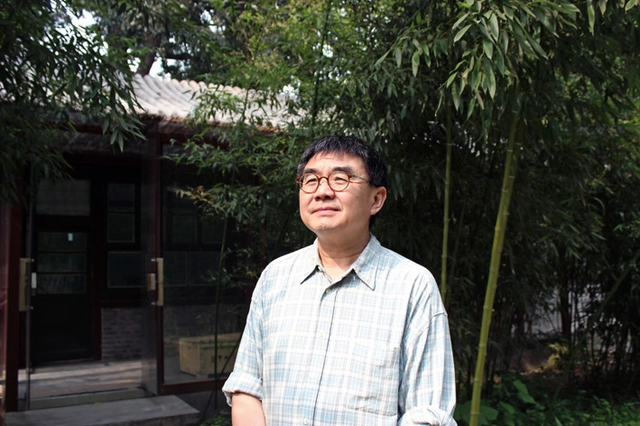
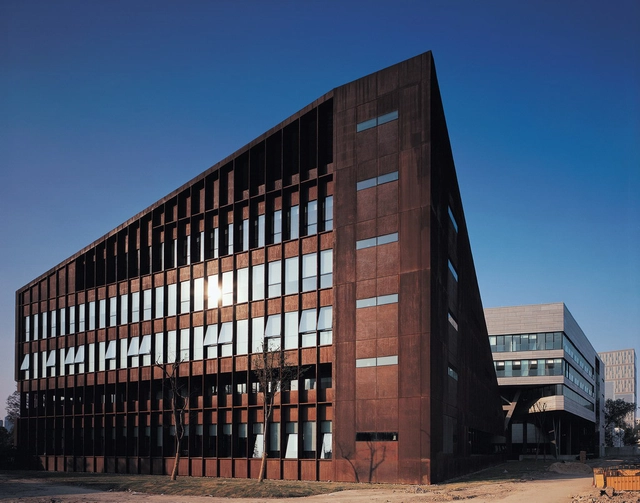
The Central Academy of Fine Arts (CAFA) in Beijing, China, has tapped award-winning Chinese architect Zhu Pei as its next dean of the School of Architecture. Zhu Pei founded his firm Studio Zhu-Pei in 2005 known for its cutting-edge integration of cultural roots and contemporary innovation in design. Zhu Pei has taught at Harvard GSD and Columbia University GSAPP, two of the leading graduate programs in the world.
"In China there’s history but there’s no existing context. All the contexts are made for the future. Most of the designs, most of the buildings are only designed for a planning scenario lasting five or ten years. And in that case, first of all, you need to accommodate functions for the future, for the planned purpose. I’d say even though the current project is in a very rural area, it could soon, let’s say in just one or two years, become a populated area. So that’s a different challenge here when you are designing in China." - Xu Tian Tian, Beijing 2013
Spontaneous Artist Community
Xu Tian Tian: What condition is Songzhuang in, in general? I haven’t been there for quite a while.
Pier Alessio Rizzardi:Songzhuang is developing very rapidly, everything was under construction, and especially in the areas around your three projects the residential buildings were growing fast… I must say that all the projects you designed [Songzhuang Artists’ Residence, Museum and Cultural Centre] were extremely damaged.
"It’s really easy to build a building. From the very beginning to the realization; it’s very easy! You just give it an interesting form and you get approved. But the real issues are how to make it user-friendly and to enhance the quality of the life of the people trying to escape the influence of the “system”. That’s the challenge. In my experience […] I’ve learned that for architects, both Chinese and foreign, the use of form to create an object is easy but how to do the right thing is very challenging." - Zhang Bin, Shanghai, Sept 2013
“Every couple of years a new manifesto appears, but how long can it last? We need more people doing instead of talking. [At Amateur Architecture Studio] we spend an enormous amount of time experimenting, trying to resurrect the craftsmanship that is almost lost. We use a method that is passed on, hand-to-hand, to re-establish tradition instead of talking about abstract but empty concepts.” - Lu Wenyu, Hangzhou, 2013
Pier Alessio Rizzardi:“A house instead of a building” is a really famous phrase of Amateur Architecture Studio. What is the meaning behind this concept?
Lu Wenyu: Once, Wang Shu said: “we only make houses, we don’t make architecture.” The house and architecture here have their own meanings. Making a house means making it for the people, making it more tranquil, or closer to nature, more humanized. Instead, architecture is an abstract concept, so many designs nowadays are actually architecture. So this sentence, from almost 20 years ago, “making houses, not architecture”, is about not making that abstract concept, but to make something really concrete and tangible, something that you can touch or that is made with your own hands… so when you see this house, you feel differently.
“If we look at architecture from a cultural point of view, we see we are in a special moment where we are trying to figure out our identity. I think we are too focused on how to transform old Chinese architecture into contemporary architecture; but in no way can you transform it, you can see it with your own eyes. For instance you cannot transform a Roman building into today’s buildings! Sometimes you have to forget about history to create contemporary and unique architecture.” - Zhu Pei, Beijing, 2013
“If you don’t know or really didn’t study the local culture, do universal design. That’ll keep the quality. If you want to do something that you don’t know, there is a big chance that it’s going to fail and have a bad impact on the city and the people here. Do it in your own way. If you do something good and beautiful back home, you should do exactly the same type and put it here. That’s also a good contribution because you show good architecture quality… Do something universal!” - Liu Xiaodu, Shenzhen, 2013
Founded in 1999, Urbanus is led by its trio of partners Meng Yan, Wang Hui and Liu Xiaodu, all of whom studied first in China and then abroad in the USA before returning to their native country at the very beginning of its construction boom. In this interview Liu Xiaodu discusses the changing realities of Chinese architecture education, the beginnings of their firm and the positive side to the “chaos” of the country's current urban expansion.
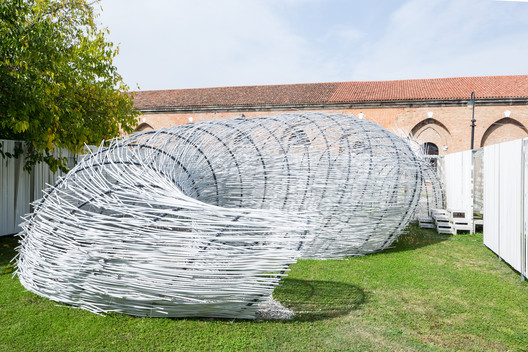
Casting complex shadows and engulfing visitors in a series of maze-like spaces, the Parasite Pavilion was constructed as part of the Synergy & Symbiosis event at the 2014 Venice Biennale, which showcased the best of the UABB Shenzhen and Hong Kong Biennale from 2005 to 2014. Based on the Bug Dome pavilion, a similar experiment from Hong Kong 2009, constructed by Weak! Architects as an icon of "illegal architecture," this new pavilion is the product of an intensive five day workshop, with the cooperation of architects and students from Europe, Australia, and China. Read on after the break to learn more about the Pavilion and Workshop.
Architecture is not important. You can make a microclimate or situation, but you cannot have more influence about life or the urban situation, it’s just a very small operation you are working on, and you cannot control the situation of the city.. But even if you are just working on a single object here, you can always try to have more or less a positive influence on the city, you can always contribute in your way to the city, to the citizens. But in a larger view it’s not that important; it’s you or somebody else. The people are happy or not, their happiness is not relying on your architecture.” - Qi Xin, Beijing, 2013
Shedding light on topics from China's rapid urbanization to the issue of copycat architecture, this interview of Chinese architect Qi Xin conducted by Pier Alessio Rizzardi questions the role of architecture in Chinese society, and reveals the mindset of the modern Chinese architect. Qi Xin's answers challenge many of the myths surrounding Chinese architecture, often through one-line gems such as “what is permanent for Chinese people is the spirit, not material,” and “the most important thing is that we don’t know where we are going... we are making the future cities.”
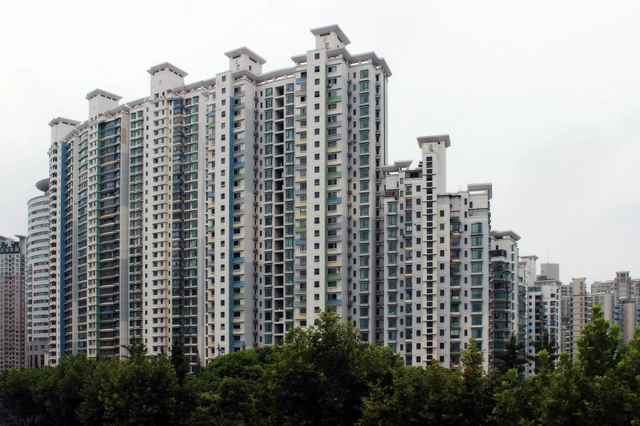
The world is looking at the urban machine of Chinese cities, at the newly founded theme-cities and at the new urban economic investment areas around the cities. The buildings are repetitive, the areas are sometimes uninhabited, but the thing that leaves urban planners, architects and the public amazed is that these buildings are often completely sold out even before they are completed.
To buy these freshly constructed residences takes money, and over the last three decades the Chinese economic miracle served precisely to grow the per capita income. The reform of the economic system in 1978 was the driving force that triggered the mechanism of capital production. The reform led to millions of people migrating to the cities from the underdeveloped west of the country in search of higher salaries and a well-founded hope of revolutionizing their economic existence.
I look into myself, trying to express myself. I think sometimes maybe you have an idea from a dream. It sounds ridiculous but you draw something out of your dream. Where does this dream come from? It must somehow relate to some situation. So what I'm interested in is to keep discovering what is really inside of me. I'm not a genius that from the first moment I already know what I want. - Ma Yansong -
Beixinqiao district, in Beijing, is changing fast: the ancient urban tissue is being demolished as new high-rises are growing.Located in this environment, Ma Yansong’s office sits within an old and anonymous construction. In contrast to its exterior, the inside is characterized by wood, white walls and plants that transform the place into a sophisticated environment.International young architects are busy modeling new organic-shaped buildings on the other side of the world; meanwhile a golden fish swims in the eternal loop of the “fish tank” in the centre of the room.
In the following interview, Ma Yansong explains contemporary cities as environments that are out-of-scale with nature. He believes a new approach must be used, one that breaks the monotonous “chessboard” of contemporary Urban China and re-establishes the balance between human beings and the natural world.
"When you find a piece of stone which is three or four hundreds years old, then you understand the notion of time as more than what we can experience as human beings. At that moment the old thing might be beautiful, it might be ugly. It doesn't matter, but it gives you a sense of profound time, and then you understand your history and ancestors that lived in a different world, different from the one we are in now."-Yung Ho Chang
Located in Beijing’s Yuanming Yuan Park, next to the ruins of the mixed-style Baroque Palace, Yung Ho Chang's office is in an ancient wooden dwelling, surrounded by vegetable gardens grown by the architects of the studio.
In this conversation, Yung Ho, who established China’s first independent architectural office, Atelier FCJZ in 1993, laying the foundation of contemporary practice in China, talks about his story, describing a Beijing which has disappeared as well as the contemporary Beijing and its "New Beijing Sky." He talks about architecture using references from movies, literature, art and artists, describing his approach to architecture in accordance with his philosophy of life.




.jpg?1431461903)
.jpg?1431461996&format=webp&width=230&height=230&crop=true)
.jpg?1431461914&format=webp&width=230&height=230&crop=true)
.jpg?1431461954&format=webp&width=230&height=230&crop=true)
.jpg?1431462140&format=webp&width=230&height=230&crop=true)