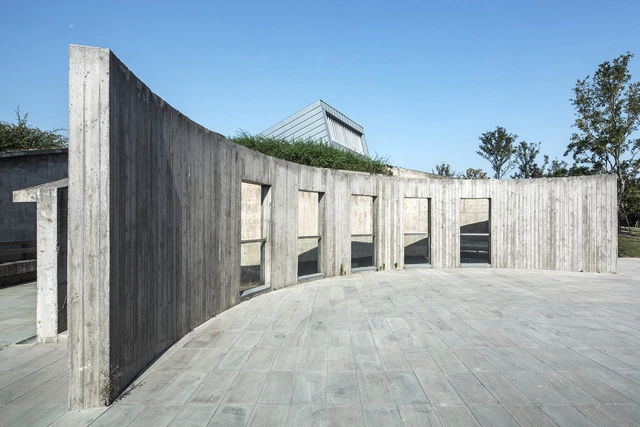
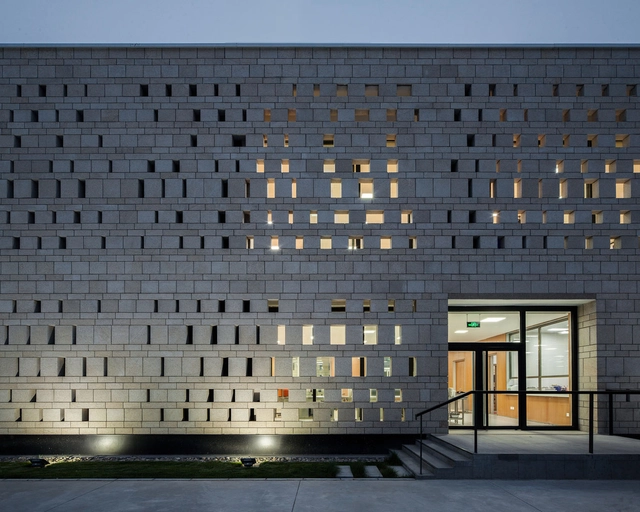
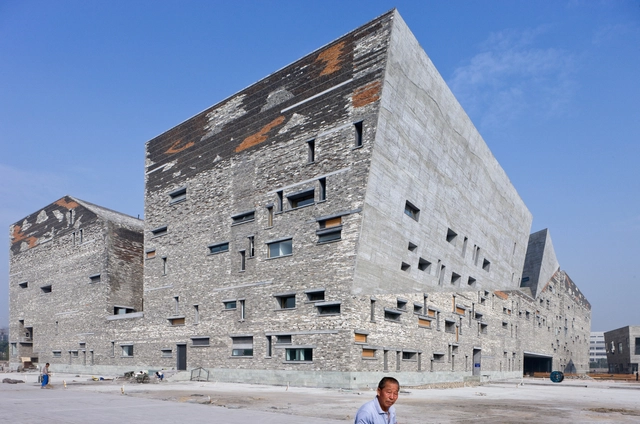
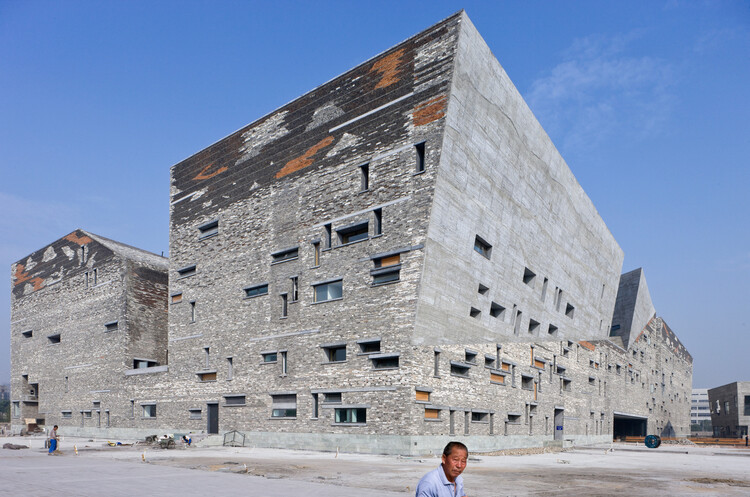
Amateur Architecture Studio, Ningbo History Museum, 2008. Image Courtesy of Louisiana
Born in 1963 in Urumqi, Xinjiang, China, architect Wang Shu has dedicated his career to defining a contemporary approach to building that is deeply rooted in China's cultural and material history. In 2012, he was recognized with the Pritzker Prize, becoming the first Chinese citizen to receive the distinction. The award jury acknowledged his body of work "for the exceptional nature and quality of his executed work, and also for his ongoing commitment to pursuing an uncompromising, responsible architecture arising from a sense of specific culture and place." In 2027, along with his wife Lu Wenyu, Wang Shu will be a curator for the Venice Architecture Biennale.
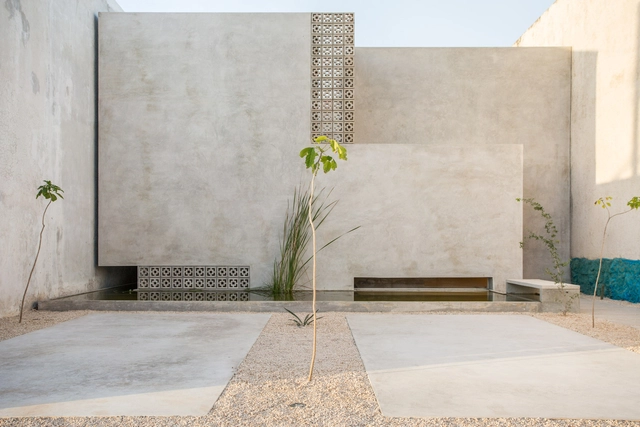
Due to its ability to mold and create different shapes, concrete is one of architecture's most popular materials. While one of its most common uses is as a humble foundation, its plasticity means that it is also used in almost all types of construction, from housing to museums, presenting a variety of details of work that deserves special attention.
Check out this collection of 40 projects that highlight the use of concrete. Impressive!
Tong Ming (b. 1968, Nanjing, China) received his bachelor’s (1990) and master’s (1993) degrees in architecture from Southeast University in Nanjing. In 1995, Tong moved to Shanghai to pursue his PhD in Urban Planning at Tongji University, which he obtained in 1999. He then worked at Suzhou Design Institute until establishing his own independent University-based practice, TM Studio in 2004. He also maintains another studio UNO, Urban Network Office space in West Bund specializing in organizing seminars, workshops, exhibitions, and lectures.
When architecture has been evolving within the context of “Chinese characteristics”, Shanghai as one of the national creative centers provides us with a glimpse of the transformations and the prospects of Chinese contemporary architecture. As a matter of fact, corporations are the main actors in shaping Shanghai’s cityscape, among which state-owned design groups play a significant role. As the chief architect of Tongji Architectural Design, Zeng Qun stays in the core of an institutional power with many large-scale built projects and has been experiencing the evolving of contemporary architecture in China. In the following excerpt from a conversation between Zeng Qun and the author, he talks about the corporation situation, the development process, the personal standpoint, and more.
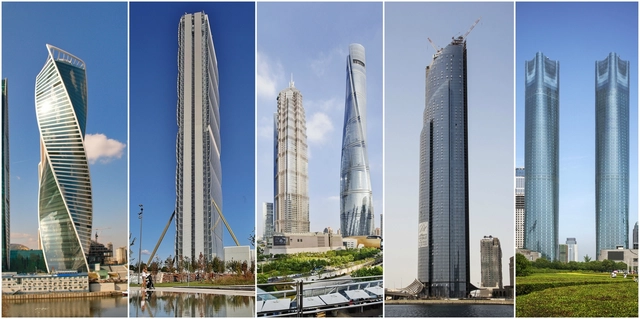
Gensler's Shanghai Tower has won the 2015 Emporis Skyscraper Award. Selected from over 300 buildings of over 100 meters in height completed in 2015, the Emporis jury was impressed by the Shanghai Tower's "elegant spiraling cylindrical shape," and the "extraordinary energy efficiency" provided, in part, by the building's double-skin facade.


.jpg?1478078308 "Hangzhou Xiangshan Campus. Image © Iwan Baan")

.jpg?1598893800&format=webp&width=230&height=230&crop=true)



_LV_Hengzhong.jpg?1466748964&format=webp&width=640&height=580)
_LV_Hengzhong.jpg?1466749162&format=webp&width=230&height=230&crop=true)
_LV_Hengzhong.jpg?1466748468&format=webp&width=230&height=230&crop=true)
_LV_Hengzhong.jpg?1466748490&format=webp&width=230&height=230&crop=true)
_LV_Hengzhong.jpg?1466748942&format=webp&width=230&height=230&crop=true)
_LV_Hengzhong.jpg?1466748964)


.jpg?1443944228&format=webp&width=230&height=230&crop=true)


_Photos_Greenland_Zifeng_SOM_05-Photo_%C2%A9_Lv_Hengzhong.jpg?1442290059&format=webp&width=640&height=580)
_Photos_Greenland_Zifeng_SOM_06-Photo_%C2%A9_Lv_Hengzhong.jpg?1442290077&format=webp&width=230&height=230&crop=true)
_Photos_Greenland_Zifeng_SOM_02-Photo_%C2%A9_Lv_Hengzhong.jpg?1442290008&format=webp&width=230&height=230&crop=true)
_Photos_Greenland_Zifeng_SOM_04-Photo_%C2%A9_Lv_Hengzhong.jpg?1442290041&format=webp&width=230&height=230&crop=true)
_Photos_Greenland_Zifeng_SOM_05-Photo_%C2%A9_Lv_Hengzhong.jpg?1442290059&format=webp&width=230&height=230&crop=true)
_Photos_Greenland_Zifeng_SOM_05-Photo_%C2%A9_Lv_Hengzhong.jpg?1442290059)