Art is not confined to gallery walls. The concept of art displayed on ceilings stretches back to the Renaissance, perhaps most notably the Sistine Chapel ceiling by Michelangelo. The Renaissance tradition of Trompel’oeil ceilings went further, using an illusionary depth of perspective to depict a volume which doesn’t exist; be it a dome that was never built or an attic filled with angels.
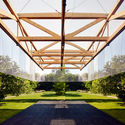
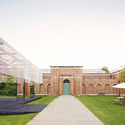
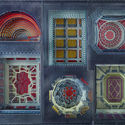
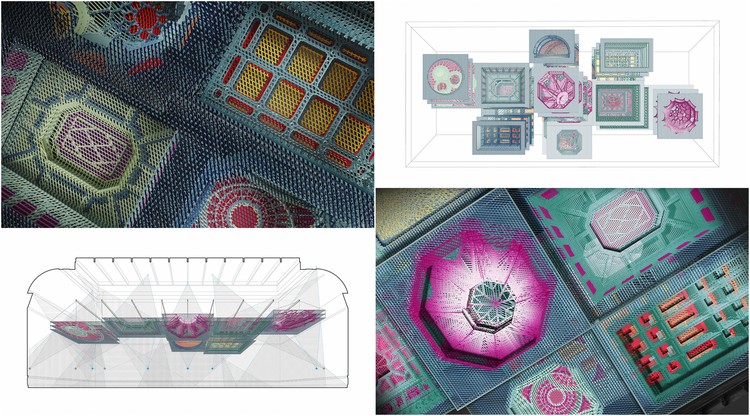
Four hundred years later, New York and Los Angeles-based architecture firm FreelandBuck has elevated the concept with its upcoming installation ‘Parallax Gap’, which has been selected by the Renwick Gallery of the Smithsonian American Art Museum as the winning entry in a competition entitled ‘ABOVE the Renwick’. From July 2017 to February 2018, the 2,500sqft canopy will be suspended from the ceiling of the Renwick’s largest room, the Bettie Rubenstein Grand Salon, depicting an abstract catalog of American architectural icons.
After a study of Madrid’s exuberantly geometric architecture, Digital Designer and Creative Director Joel Filipe continues his formal exploration in a series of photos of the MAAT by AL_A that celebrates the delicate impression of its undulating white tile facade against the bright Lisbon sky. Situated on the Tagus River, architect Amanda Levete creates a reunion between the river and the city with MAAT’s walkable rooftop terrace that draws visitors from the nearby streets of Belem, and with the promenade which steps down to meet the water. The roof provides a gathering space during the day and a place to screen films at night. The low-lying gentle arch of the building allows for a clever play of shadows and light, along with a nod to rippling water.
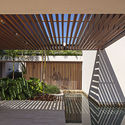
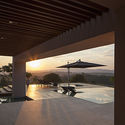
On a tree-lined avenue in Singapore, fittingly named Orchard Road, Apple has opened its first Flagship store in the city-state, highlighting its role as a global center for creativity and innovation. Designed by Fosters + Partners, in collaboration with the design team at Apple, the Orchard Road Flagship seeks to create a new social focus by working in tandem with nature, blurring the boundaries between inside and out.
https://www.archdaily.com/872749/apple-opens-its-first-flagship-store-in-singaporeNiall Patrick Walsh
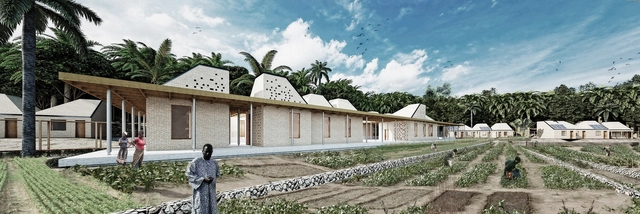
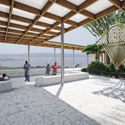
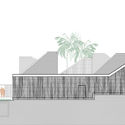
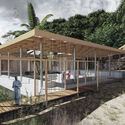
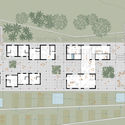
With a modular composition inspired by traditional sub-Saharan African building typologies, MASA Studio’s safe lodging proposal for Tanzanian cancer victims has been selected as the winner of the Hostels for Hope competition, which called for solutions to issues of health and safety in regards to the rehabilitation of cancer victims away from home in rural Africa. Organized by Pink Ribbon Red Ribbon, an international foundation combatting women’s cancers, the competition responds to the unfortunate decision that thousands of Tanzanian women have to make every year – to travel great lengths for unaffordable treatment and lodging, or to remain at home unable to fight the disease.
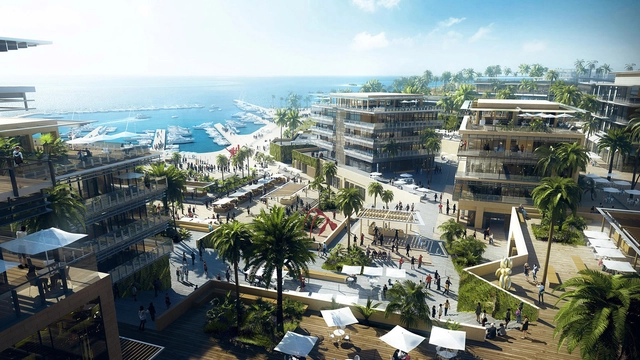
International Architecture office 10 Design has released their first images of their Jefaira Seafront Development along Egypt’s North Coast. Spanning 550 hectares, the site stretches 3km along the Mediterranean coastline. The project is in collaboration with INERTIA, one of Egypt’s prominent real-estate developers leading various luxury residential and commercial developments across the country.
Danish-based landscape architects SLA have won a competition to develop The New Hedeland Nature Park – a 1,500-hectare cultural landscape near the historical city of Roskilde, Denmark. The winning proposal challenges the common idea of the conventional “culture house” as it is moved out in the open without walls and roofs, making participating accessible for everyone. The winning design also seeks to complement the area's unique nature and 10,000 years of cultural history into one coherent concept, creating new space for co-creation, interaction, and awareness.
A new train station in Cambridge is getting a lot of attention from a surprising audience: mathematicians. Cambridge North Station is clad in aluminum panels with a geometrical cutout design. The architecture firm, Atkins, originally claimed that the pattern was derived from Cambridge alumnus John Conway’s “Game of Life,” but eagle-eyed mathematicians soon realized that was incorrect. As the above video points out, the design is in fact based on a mathematical rule studied by Stephen Wolfram, an Oxford alumnus, much to the dismay of rival university Cambridge. Though the firm’s website still references Conway, a Senior Architectural Designer at Atkins, Quintin Doyle, has since confirmed that it was, in fact, Wolfram’s Rule 30 that they used in the design.
Praksis Arkitekter has been awarded 500,000 DKK as winners of Nykredit's Architecture Awards, the most prestigious architectural distinction in Scandinavia. Founded in 1987 by the Nykredit Foundation, the awards also honored two practices with 250,000 DKK Prizes: the Motivation Award, won by ADEPT, is “an encouragement to continue and further develop an already obvious talent” seen in young architectural practices, while the Sustainability Award, which was introduced in 2016, was won this year by Leth & Gori.















_Nigel_Young_l_Foster___Partners_2317_FP619882.jpg?1496385984&format=webp&width=640&height=580)
_Nigel_Young_l_Foster___Partners_2317_FP619882.jpg?1496385984 "Courtesy of Nigel Young l Foster + Partners")
_Nigel_Young_l_Foster___Partners_2317_FP619883.jpg?1496385944 "Courtesy of Nigel Young l Foster + Partners")
_Nigel_Young_l_Foster___Partners_2317_FP619884.jpg?1496386049 "Courtesy of Nigel Young l Foster + Partners")
_Nigel_Young_l_Foster___Partners_2317_FP619885.jpg?1496386156 "Courtesy of Nigel Young l Foster + Partners")
_Nigel_Young_l_Foster___Partners_2317_FP619882.jpg?1496385984)